 By admin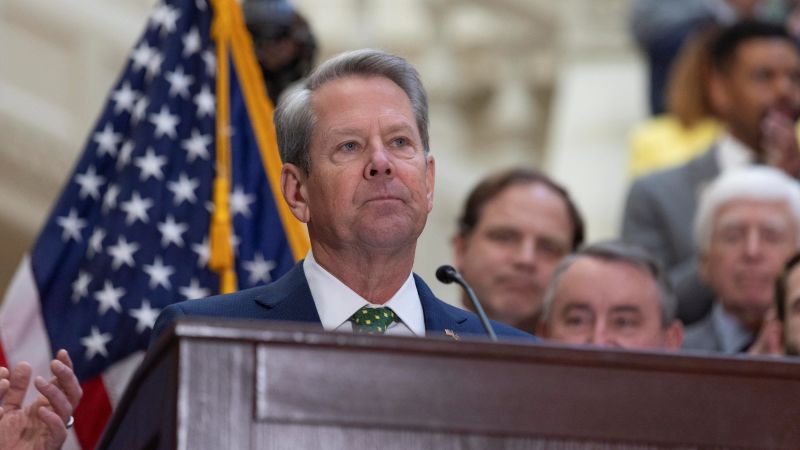
AtlantaAP —
Georgia’s Republican legislative leaders on Wednesday rejected Gov. Brian Kemp’s call to redraw congressional and legislative districts during a special session, citing concerns about moving too quickly after a US Supreme Court decision weakened federal Voting Rights Act protections for minority voters.
Read more Thwarted attack on UFC fight is another reason to build White House ballroom, Trump DOJ argues
House Speaker Jon Burns sent Kemp a letter hours before a special session was set to begin Wednesday, and he announced the decision as demonstrators filled the Georgia Capitol with chants of “Black voters matter!”
The decision marked a setback for both Kemp and President Donald Trump, who has urged Republican-led states to redraw congressional districts to their advantage. Ten states already have enacted new congressional districts ahead of the November midterm elections. Georgia would have been the first to change districts for the 2028 elections.
Burns said lawmakers want to take their time after the court’s decision in Louisiana v. Callais, which struck down Louisiana’s congressional map as an illegal racial gerrymander and laid the groundwork for other Southern states to redraw their congressional districts. Burns said it was more important for lawmakers to focus on economic matters rather than “partisan games.” He also cited pending litigation over existing Georgia districts and the need for the state to understand the full ramifications for how race can or cannot be used in redistricting.
Republican legislative leaders did not rule out revisiting redistricting later this year.
Minority voting rights are especially salient in Georgia, where the Capitol complex includes a statue of the Rev. Martin Luther King Jr. and sits blocks from where the slain civil rights icon lived, preached and led the movement that yielded the Voting Rights Act in 1965.
Read more On Iran, Trump is committing the cardinal sin from the ‘Art of the Deal’
It’s not guaranteed that Georgia Republicans can get what they want from potential new maps.
Partisan gerrymandering involves redistributing voters — packing certain citizens into fewer districts or dividing them across more districts. Around metro Atlanta, spreading non-White, Democratic-leaning voters across more districts could make more seats seem to lean Republican. The risk, however, is that more battleground districts emerge because White metropolitan voters are trending less conservative, which could give Democratic candidates of any race or ethnicity more chances to win.
That’s perhaps not a major factor in the Georgia state Senate, which already is considered gerrymandered for Republicans. But it could be a consideration when drawing state House and US House maps.
Kemp was effectively asking Republicans, especially in metro Atlanta, to redraw their own boundaries and take on new, unfamiliar territory.
Read more How to read the US-Iran draft agreement: Big commitments from Washington, not from Tehran