 By admin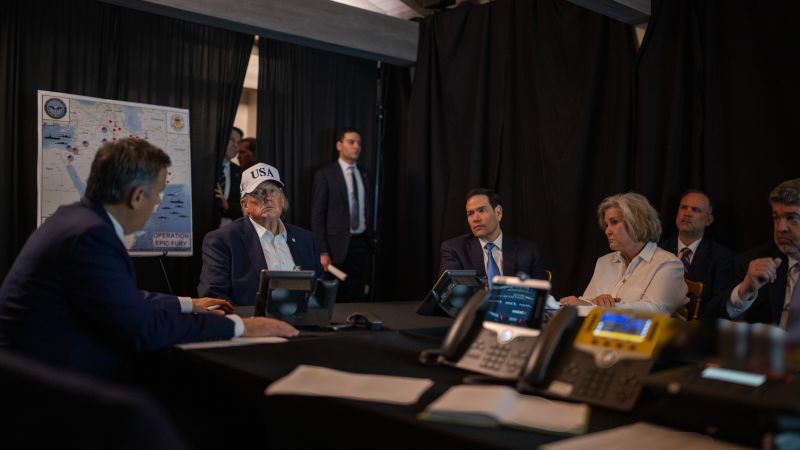
- Trump slashed the National Security Council staff from roughly 200 to less than 100 in the past year, sources say.
- Former officials say the reduced NSC missed opportunities to coordinate with allies and assess Iran’s willingness to close the Strait of Hormuz.
- Trump has relied on a small group of advisers rather than the broad network of experts that typically inform war planning.
Worried about a president who seemed to be flying by the seat of his pants as he waged war, Congress stepped in to establish a council of experts to advise the president, gathering information from across the government to consider the consequences and effects of military action.
Read more Why Trump’s secret and vague MOU is stirring a political storm
The president was Franklin D. Roosevelt and the war was World War II. The advisory body Congress created, the National Security Council, served the next 14 presidents in the intervening decades as a key nexus for information and planning.
However, in the last year under President Donald Trump, the NSC has been largely gutted in the lead up to a war with Iran that has seen Trump shuffle through a series of strategies.
Trump slashed the council’s staff from roughly 200 in the early days to less than half of that today, according to estimates from three sources. Trump made the cuts, at least in part, at the behest of far-right conspiracy theorist Laura Loomer who claimed that the NSC was full of people who were inadequately loyal to Trump.
Instead of using the council to draw on input from a vast federal network of experts, Trump has leaned on a small group of close allies, such as national security adviser Marco Rubio and envoy Steve Witkoff, when debating strategy for the war. That has presented challenges for military planners, who were kept at arm’s length from pre-war discussions before being abruptly tasked with moving US assets to the Middle East, CNN has reported.
“There’s no doubt there were missed opportunities with a smaller NSC” ahead of Trump’s decision to attack Iran on February 28, one former Trump administration official told CNN.
The hollowing out of the NSC has altered US foreign policy at key moments of the wars in Iran and Ukraine while catering to Trump’s shoot-from-the-hip management style, four veterans of Trump’s second term said in interviews with CNN.
There are some benefits to a smaller NSC, including that it means there’s less bureaucracy to navigate when crises occur, two of the former officials said.
But a larger NSC could have helped Trump better coordinate with Gulf allies over Iran’s response to US military strikes and facilitated a more “thorough” discussion of Tehran’s willingness to effectively close the Strait of Hormuz, the former official said.
Instead, Trump told CNN in March the “biggest surprise” of the war was the ferocity with which Tehran hit Arab Gulf states with missile strikes. The administration also significantly underestimated Iran’s willingness to close the strait, despite the military having war-gammed that exact scenario for years, CNN previously reported.
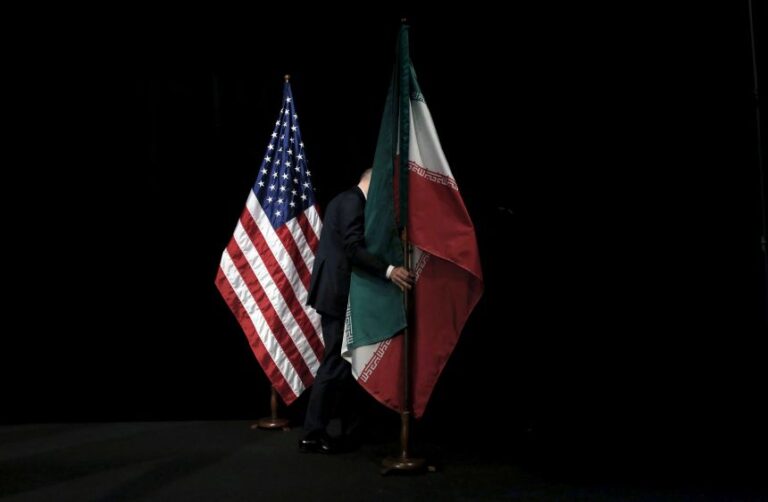
The NSC had a prime role in the deal the Obama administration reached, in 2015, to monitor Iran’s nuclear program. Robert Malley, a lead negotiator for the deal, also served as a senior NSC official. Nate Swanson, who was an Iran-focused State Department official at the time, said the NSC was “extremely involved” in shaping and implementing the deal and held numerous meetings on the subject.
“The NSC is more effective and responsive to the President’s priorities than ever before,” White House spokesperson Anna Kelly said in a statement.
“Any suggestion that all of the relevant entities – including the Department of War, Department of State, Department of Energy, Department of the Treasury, Central Intelligence Agency, and more – were not involved over the course of Operation Epic Fury and beyond is laughable,” Kelly added. “The President meets frequently with his national security team and listens to a variety of opinions on any given issue. Ultimately, he is the final decisionmaker.”
While key officials from agencies including the Departments of Energy and Treasury were present for some of the early planning meetings before the US attacked Iran, sources briefed on the meetings said, the agency analyses and forecasts that would have been integral elements of the decision-making process in past administrations were secondary considerations.
Sriprakash Kothari, whom Trump nominated to be assistant Treasury secretary for economic policy, told Senate staff that he was unaware of anyone at Treasury who conducted analysis or work related to energy markets before the US military operation against Iran, according to Sen. Ron Wyden, the top Democrat on the finance committee.
Treasury Secretary Scott Bessent the Treasury “relies on hundreds of career economic experts” and others to provide Bessent with advice. (Bessent did not specify whether those advisers did so in relation to the Iran war.)
“The cabinet departments can do a lot of the heavy lifting, but the distilling of complicated information at scale is what the NSC thrives at,” the former official said.
Cost of cuts
About a fifth of the world’s oil flows through the Strait of Hormuz, and Iran leveraged its closure to try to extract concessions from the US during negotiations to end the war. Trump announced a framework agreement between the the US and Iran Sunday ahead of a planned formal signing on Friday.
A lack of coordination across federal agencies was evident in the Pentagon’s early decision to prioritize attacks against Iranian military targets rather than dedicating assets to deterring Iran from attempting to close the strait, two sources familiar with the planning discussions at the time said.

While the US had significant military assets in the Middle East before the US attack on Iran, those assets weren’t suited for preventing Iran from closing the strait, one of the sources said.
“After bombs started falling, there is nothing else the carrier strike groups could have provided that would have changed the calculus on closure,” the source told CNN.
“Through a detailed planning process, the Department of War was prepared for any potential action taken by the Iranian regime,” said Kelly, the White House spokesperson. “Any suggestion otherwise is laughable.”
Read more Trump beats a longtime adversary with a late Georgia endorsement, and other election takeaways
Since its inception, the NSC has periodically frustrated some Pentagon officials who have seen it as a power grab of their war-planning duties. That was true during the Biden administration, where the NSC staff numbered well over 300 people. But few presidents have taken a sledgehammer to the NSC the way Trump has. It was the Stephen Miller-led Homeland Security Council, a body created in the wake of 9/11 to deal with threats to the US homeland, that was the hub for drawing up plans for a post-Maduro Venezuela.
Swanson, who went on to serve as an Iran adviser at the NSC in the first Trump and Biden administrations, described the NSC in Trump’s first term as having one of the most rigorous schedules of any NSC he was aware of. That included a heavy cadence of meetings on Iran, Swanson said.
In the second Trump term, the administration appears to have “abandoned the process altogether,” he told CNN.
Swanson served on the State Department’s Iran negotiating team at the beginning of Trump’s second term until he was ousted after Loomer complained that he was an “Obama holdover.”
“This [NSC now] seems to be exclusively top-down decision making and fear of bringing bad news to the president,” Swanson said.
What the NSC is intended to do
Before President George HW Bush ordered a US military response to Saddam Hussein’s 1990 invasion of Kuwait, Bush’s National Security Council held a flurry of meetings to debate the merits of miliary action.
Representatives from the Pentagon, spy agencies and the State and Treasury departments were all at the table, providing updates to National Security Adviser Brent Scowcroft or his deputies. State Department officials reported on their efforts to build what would become a coalition of dozens of countries to support military action against Hussein. Treasury officials reported on their work with foreign counterparts to enforce a blockade of Iraq and stabilize the oil market.
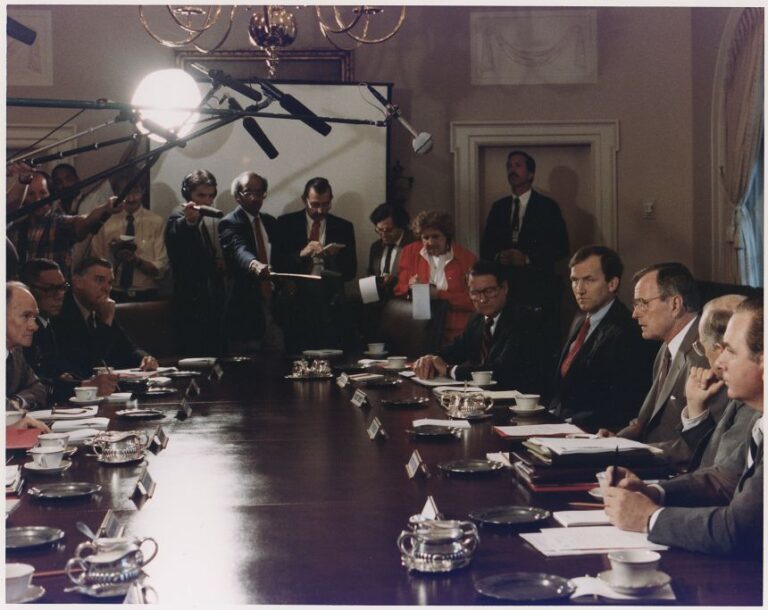
It was the sort of coordination that the council was designed to facilitate, in line with what Congress intended in 1947 when the NSC was created in the wake of Roosevelt’s prosecution of WWII.
The NSC was a way of forcing people from across the federal bureaucracy into a room to produce decision-making information for the president, and to track how those policies were executed, according to historian and former Pentagon speechwriter John Gans.
Policy experts take leave from various agencies to report to the Eisenhower Executive Office Building next to the White House.
“The NSC was created because people were very scared during World War II that you had a president, who ended up dying in office, who was basically running a global war by the seat of his pants,” said Gans, whose book “White House Warriors” chronicles how presidents have used, and been used by, the NSC in times of war.
There are positives and negatives to having a robust NSC able to provide ample advice.
“A larger NSC can handle more topics simultaneously, but there’s also the danger of a bureaucracy believing it can make decisions that rightfully belong to [the president],” the first former official said.
“This is not a traditional administration,” another former Trump official said. “The president and his top officials are the ones dictating policy, so it’s a top-down approach rather than bottom-up. It certainly is way more efficient this way.”
That former official argued that Trump was able to put together a plan to end the war in Gaza far more efficiently than if he had kept the NSC bureaucracy in place.
But in other cases, bureaucracy, or a single bureaucrat, has arguably still gotten in the way. At the start of Trump’s second term, nearly every NSC hiring decision had to go through Sergio Gor, then the head of the White House personnel office, according to a third former US official. As the war in Gaza raged, the NSC’s Middle East directorate had only a few people because Gor was blocking some new hires, the source said.
Since World War II, every American president has grown frustrated with the bureaucracy or press leaks and shrunk the size of their circle of advisers, according to Gans. Even President George HW Bush, who Gans called the “gold standard” for NSC management during the First Gulf War, “basically stopped” calling meetings of the formal council as the war progressed, Gans said.
One of the clearest signs of the NSC’s removal from the national security decision-making process came last July, when Defense Secretary Pete Hegseth did not inform the White House about his decision to pause weapons shipments to Ukraine. It was the second time in 2025 that Hegseth had decided to halt the flow of US weapons to Ukraine, catching senior national security officials off guard, CNN previously reported.
When a reporter asked during a Cabinet meeting who authorized halting the weapons shipment, Trump replied, “I don’t know, why don’t you tell me?”
“It’s kind of a miracle we haven’t seen more” public examples like that of the NSC being blindsided by big national security decisions, the third former official said.
CNN’s Arpita Dasika contributed to this report.