 By admin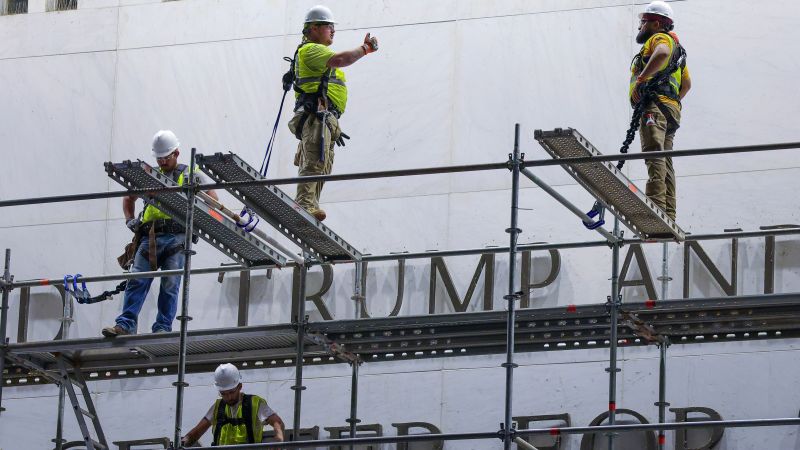
- President Donald Trump’s second-term vanity projects around Washington, DC, are hitting a series of legal and logistical roadblocks.
- The most recent setbacks came at the Kennedy Center and the Reflecting Pool.
- His pet projects were already unpopular, but now they’re looking rushed and not totally thought through.
President Donald Trump’s efforts to turn his second term into a big vanity project largely focused on himself are looking increasingly messy.
Read more Gavin Newsom says Trump Justice Department is investigating him
It would be one thing for him to go to such great lengths to build an elaborate White House ballroom and slap his name on buildings in the best of times; but Trump’s timing would seem exceedingly tone deaf, given most Americans are more concerned about their own pocketbooks than honoring a historically unpopular president.
And repeatedly in recent days and weeks, the administration’s initiatives have run into roadblocks and its efforts to embellish Washington, DC, (often by skirting the law) have looked rather haphazard.
Perhaps most striking was Trump’s setback at the Kennedy Center.
After he effectively hijacked the center’s board by installing loyalists, the board moved to — surprise! — put Trump’s name on the building late last year. They added it alongside the deceased president whose name was on the building as a matter of federal law.
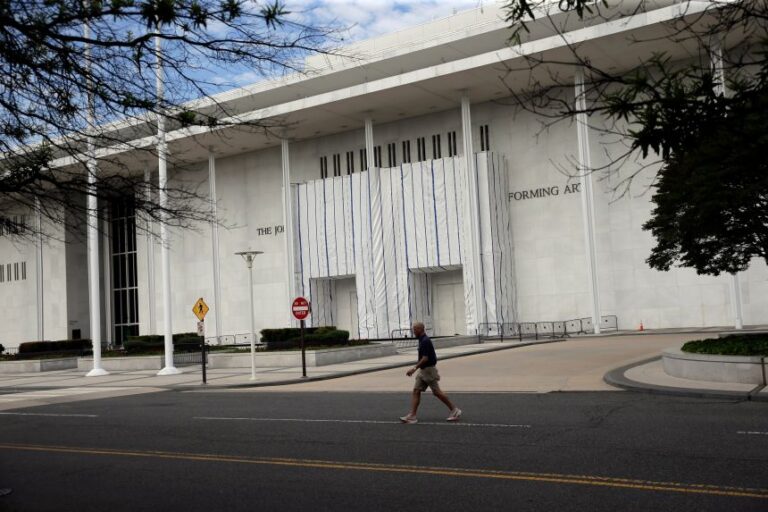
But after the courts predictably ruled that was illegal, the administration has had to confront the optics of taking Trump’s name off the building. As I wrote earlier this month, that removal threatened to be “an indelible — and telling — image.”
And lo, when the Kennedy Center was compelled to take Trump’s name off the building this weekend, it was conveniently done in the middle of the night. Scaffolding was constructed and tarps were hung to obstruct those assembled from viewing it.
By Monday, the face of the building was still covered up.
Speaking of things not exactly going according to plan: Trump and many allies have celebrated his administration’s legally dubious effort to paint the bottom of the Lincoln Memorial’s Reflecting Pool dark blue.
While perhaps a commendable idea, the cost of the project ballooned from Trump’s initial estimate of $1.8 million to more than $14 million. The contractor was also given a no-bid contract, which is generally reserved for special circumstances. The New York Times also reported that the company was allowed a profit margin much higher than normal, according to a National Park Service analysis.
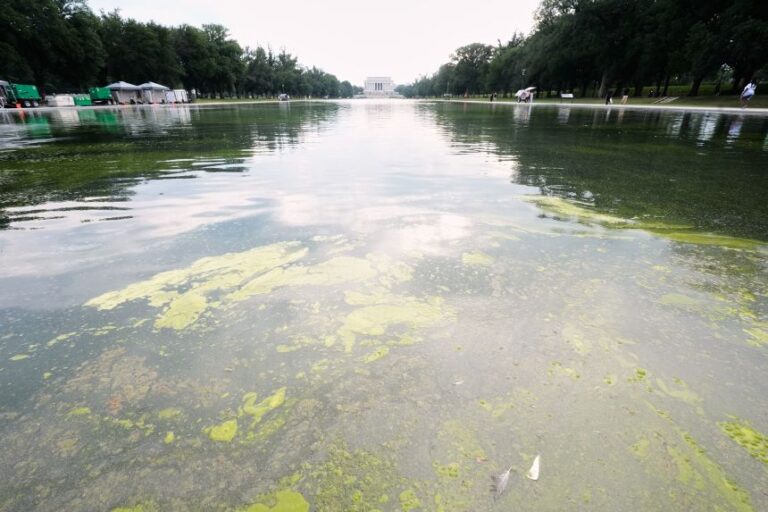
And now, less than a week after Trump announced the project was finished, the Reflecting Pool has been overrun with algae, turning the water a familiar shade of green.
The National Park Service is dealing with the issue and is projecting optimism that it can be remedied. Employees were in the pool in hip-waders on Sunday sweeping the algae toward nanobubbling machines to kill it. But the problem has proven stubborn before.
And Trump seems to have taken notice of it. On Monday morning, he posted an article from a friendly news outlet thanking him for making the Reflecting Pool so beautiful again.
Except the article is a week old.
The last couple of days have also reinforced how Trump’s stewardship of the country’s 250th anniversary celebration is politicizing it.
Read more Parents are tracking their adult children for safety. But is it actually safer?
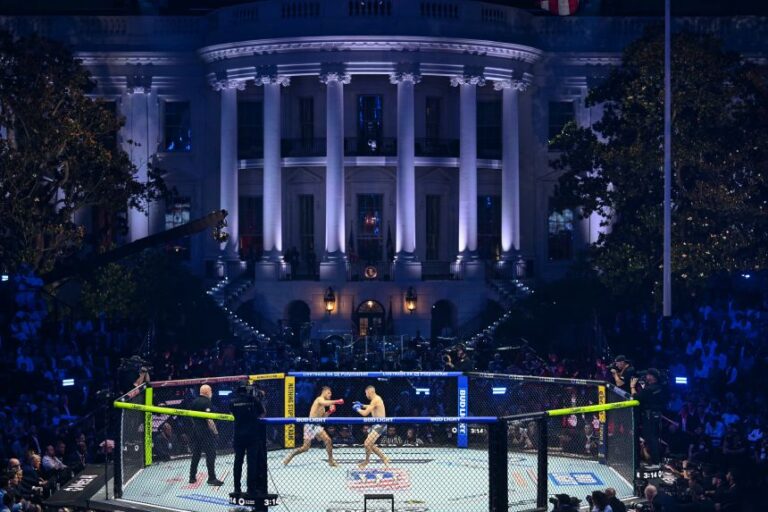
The UFC fights held on the South Lawn of the White House on Trump’s 80th birthday avoided potentially problematic weather. But what was otherwise thought to be a successful program was marred by one of the fighters grabbing a microphone and falsely declaring that former first lady Michelle Obama is a man (a popular but ridiculous conspiracy theory in the fever swamps of the internet). While UFC CEO and President Dana White criticized the offensive comment, the White House has not.
And as if it wasn’t already clear, Trump on Monday perhaps unwittingly suggested the celebration of the country’s 250th anniversary would also be, at least in large part, a celebration of him.
In a social media post, he said the celebration on the National Mall on July 4 will be the “most spectacular TRUMP RALLY of them all.”
It’s not surprising Trump would make these events about himself; this is part of a pattern. But a few weeks back, when a series of musical acts were canceling their scheduled appearances over politicization concerns, the administration and organizers pretended it was a non-issue.
A spokesperson for Freedom 250 called the events “inherently nonpolitical.”
Interior Secretary Doug Burgum, meanwhile, told Dana Bash on CNN’s “State of the Union” in May that “this Freedom 250 and the celebration of the 250th is a nonpartisan event.”
Trump has also dealt with a series of other setbacks in recent weeks.
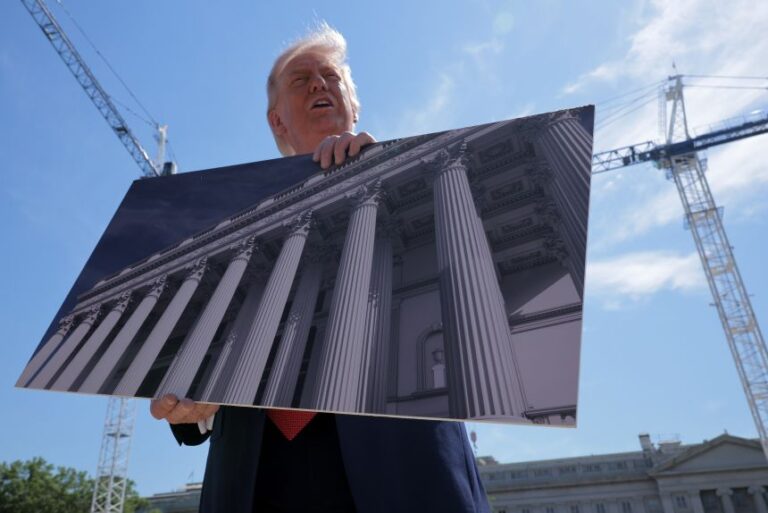
On his ballroom, Senate Republicans stripped a provision from an immigration bill that would have provided the White House’s requested security funding for the project (which Trump said repeatedly would be fully privately funded). Then seven Senate Republicans backed a measure attempting to block the funding from ever being passed.
The administration was also forced to retrench on reports that it was potentially planning to print a commemorative $250 bill with Trump’s face on it. This appears to be illegal, given living people can’t appear on currency. And soon enough, the White House acknowledged Congress would have to change the law (which won’t happen).
The $250 bill is a great example of how many of these ideas seem rather suspect, politically speaking. When the Treasury Department moved to merely put Trump’s signature on currency, a Washington Post-ABC News poll showed Americans opposed it 68%-12%.
Trump’s ballroom and his proposed 250-foot triumphal arch also polled quite poorly. And ahead of the UFC event at the White House this weekend, a Reuters-Ipsos poll showed just 16% of Americans said it was “appropriate” to hold such an event on White House grounds, compared to 46% who said it was not.
It’s almost like very few people in America seem to be asking for these things — few people except Trump, that is. Americans don’t seem to want to build monuments to an incumbent president whose approval rating is mired in the 30s. And it’s looking like much of this effort is rather rushed and not totally thought through.
Trump just keeps pursuing it, though.