 By admin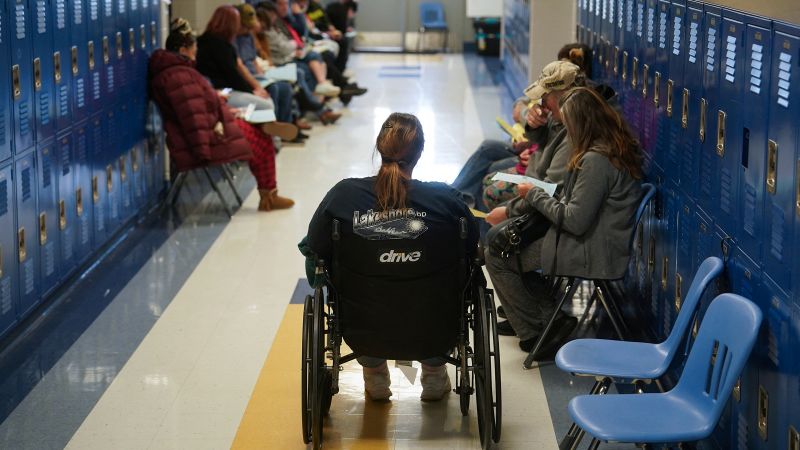
Even as health care issues rise in the 2026 campaign debate, new data show that far more House Republicans than Democrats represent districts where the most residents face major medical challenges — and lack health insurance.
Read more Former Olympic canoeist indicted by a grand jury after arrest at the Reflecting Pool
An exclusive CNN analysis of data collected by the Congressional District Health Dashboard project finds that significantly more House Republicans than Democrats hold seats where an elevated proportion of residents are experiencing such significant health problems as diabetes, high blood pressure, obesity, and deaths from cardiovascular problems or breast cancer. Likewise, many more House Republicans than Democrats now represent districts where the share of residents who are uninsured exceeds the national average.
In a powerful measure that crystallizes all these disparities, results from the dashboard show that nearly 70% of House Democrats represent districts where life expectancy now exceeds the national average — while life expectancy lags below the national average in over 70% of Republican seats.
These stark disparities provide a dramatic backdrop for the escalating campaign confrontations over health care. In their 2026 messaging, Democrats and their allied groups are aggressively condemning the Republican moves last year to cut Medicaid in the “One Big Beautiful Bill” and to allow the expiration of enhanced subsidies under the Affordable Care Act.
Polls consistently show that most Americans oppose those health care cuts. The paradox is that concern about health care may help Democrats more in swing districts that are less immediately affected by the GOP cuts than in the seats that face the most direct impacts.
Many of the GOP districts with the worst health outcomes and the lowest levels of health insurance are predominantly White, culturally conservative rural places, often in the South. In most of those districts, President Donald Trump won overwhelming majorities in 2024, and Democrats have struggled to compete at all.
Michael Shepherd, assistant professor at the University of Michigan school of public health, and author of an upcoming book “Rural Pain, Republican Gain,” says his research shows that deteriorating health outcomes appear to have strengthened the GOP in small towns and rural communities experiencing them. “Those worse outcomes lead those White voters to blame the Democratic Party for their bad health, in part because they are blaming the government vaguely and they associate the Democratic Party with government,” he says.
No longer the ‘wealthy and healthy party’
The Congressional District Health Dashboard is a partnership between the New York University Grossman School of Medicine and the Robert Wood Johnson Foundation. The project uses federal data from the Census Bureau; the Centers for Disease Control and Prevention; the National Center for Health Statistics; and other sources to calculate whether each congressional district ranks above or below the average for all districts nationwide on 40 different metrics of health status. The NYU researchers updated many of the measures this spring with the most recent available data.
CNN senior producer Edward Wu analyzed the data to compare the health status of House districts held by Republicans and Democrats
The dashboard’s latest results reflect the district lines that were used in the 2024 election. Ben Spoer, program director of the Congressional District Health Dashboard, says the analysts expect that by next March they can update many of the measures to reflect the new districts created by the waves of gerrymandering in recent months.
The latest results vividly capture the class inversion that has reshaped each party’s coalition over roughly the past half century. In the House, Democrats now rely primarily on an upstairs-downstairs coalition of seats that revolve around college-educated suburban voters of all races and urban districts dominated by more economically struggling racial minorities. Republicans meanwhile hold far fewer House seats than they once did in affluent suburban areas and instead depend mostly on exurban, small-town and rural seats with large populations of economically squeezed White voters without a four-year college degree.
As the GOP’s electoral coalition has evolved, “the health composition of the Republican Party has shifted from being the ‘wealthy and healthy party’ to, at least in terms of white Americans, (representing) some of the worst health observed in the country,” says Shepherd.
Consistently across the measures that the dashboard tracks, more Republicans than Democrats hold seats where the share of residents confronting serious health problems exceeds the national average. That pattern holds for high blood pressure, obesity, deaths from breast and colorectal cancer, cardiovascular deaths, diabetes, teen births and firearm suicides, among other problems. (Somewhat surprisingly, elevated levels of opioid overdoses are slightly more common in Democratic than Republican districts). Looming over all these trends is the disparity in health insurance: 54% of House Republicans, compared to just 31% of House Democrats, hold seats where the share of uninsured people is higher than the national share.
“What you really don’t want to see is a situation where there’s a greater prevalence of chronic conditions in places that have even lower than average insurance coverage because the implications of that for prevention and management are dire,” says Marc Gourevitch, a professor of population health at the NYU medical school and co-principal investigator for the dashboard.
Joseph Antos, a senior fellow emeritus at the conservative American Enterprise Institute, says these disparities are not surprising given the shifting nature of the voters each side now primarily represents.
Republican districts now “skew blue collar and rural, so residents are more likely to have physically demanding jobs, they may be more exposed to greater health risks (related to occupation, environment — think coal and steel industries, for example),” Antos said in an email. “Rural areas don’t have major medical centers by and large, and it can be difficult to get even basic health care.” Further, Antos notes, rural residents are “less likely to have health insurance.”
Jennifer Karas Montez, a Syracuse University sociologist who studies US life expectancy, points also to diverging policy choices between blue and red states. (Both parties now rely on the states that lean most reliably toward them in presidential elections for about two-thirds of their House members.) She notes that income support for low-income families, health care coverage, vaccine acceptance, and measures to discourage smoking and firearm violence are all much more prevalent in blue than red states, while Democratic-leaning metro areas also tend to have more public amenities than red-leaning smaller communities.
“What’s been happening over the last 40-50 years is that any given place tends to either have all the things that extend our lives, or all the things that cut our lives short,” she said in an email.
Disparities between districts
Among Whites, the gap between Republican and Democratic districts is even larger than it is for all residents on several measures, including firearm homicides and both teen births and low birthweight births. The average share of White residents who lack health insurance is nearly 50% higher in red than blue districts.
Read more US service member arrested at Capitol after calling for Trump’s impeachment
Nonetheless, every House Republican voted for the reconciliation bill last summer that imposed the largest cuts ever on the Medicaid program. The GOP Congress last year also refused to extend the enhanced subsidies for the ACA that Democrats had approved under President Joe Biden. In a recent study analyzing federal data, Protect our Care, a liberal health care advocacy group, found that total enrollment in the two programs has already declined by five million since June 2025.
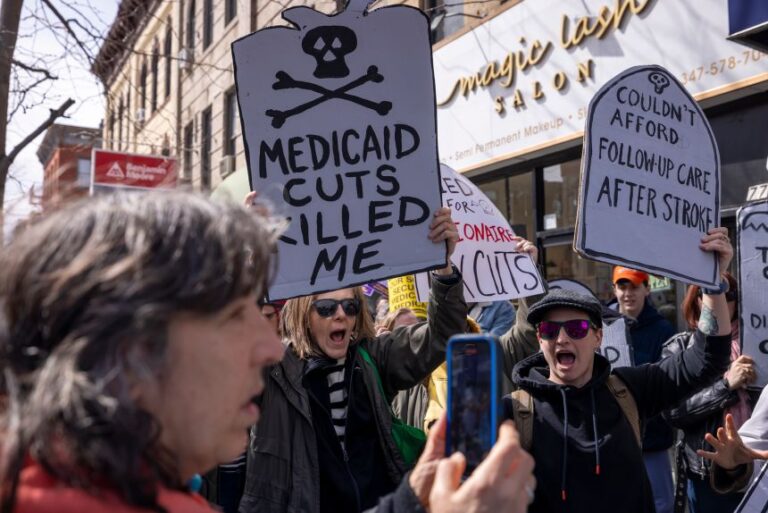
Democrats hope to make the health care cuts a central plank in their case that Republicans have compounded the affordability problem that Trump pledged to solve. But the districts Democrats are targeting this year include almost none of the mostly Southern seats with the absolute largest number of uninsured, according to the NYU data.
Larry Levitt, executive vice president for policy for KFF, a non-partisan health care thinktank, says that doesn’t surprise him. While uninsured people may support federal health care spending in the abstract Levitt says, KFF’s polling shows that once “Republican leaders and President Trump are calling for (cuts) Republican voters are going to follow. It really depends on how things are framed.”
By contrast, the swing, heavily blue-collar districts in states including Pennsylvania, Michigan, Wisconsin, Iowa and Ohio where Democrats are stressing health care issues tend to be places where the number of uninsured runs at, or even slightly below, the national average of around 10%.
In those districts, voters probably see the Medicaid and ACA cuts less as a personal threat than as a symbol of misplaced GOP priorities and a failure to address their anxieties over cost and coverage, political strategists say. Even “a lot of people who aren’t on these programs” worry about the impact of the cuts on their ability to afford care, says Leslie Dach, founder and chair of Protect Our Care. “You can’t underestimate the strain that people have” about affording health care, he says.
Whatever the impact of the GOP cuts in swing districts, the lack of debate over them in the deep red seats where their impact is greatest extends a long pattern, Shepherd says. In his upcoming book he presents evidence that rural areas suffering through damaging health trends-a hospital shutdown, or a spike in opioid or firearm deaths-tend to shift further toward Republicans. That’s even though those problems, he notes, are routinely exacerbated by GOP health care cuts at the federal level, or a state refusal to expand Medicaid eligibility — and might be ameliorated by Democratic proposals to increase coverage.
The tendency in these places to blame Democrats, as the perceived party of government, for negative health events, Shepherd says, “creates what I call the rural health spiral: bad health outcomes lead to more Republican voting, and more Republican voting leads to policies that makes the health care outcomes even worse.”
‘A decade behind’ on life expectancy
Experts agree the best measure of the hardening health divide is the difference in life expectancy between red and blue districts. “It’s a very powerful summary measure of health that reflects the totality of the exposures good and bad that people have along their life course,” says NYU’s Gourevitch.
On average, residents in blue districts can expect to live 79.9 years, about two years longer than the 77.7-year average lifespan in red districts. To put that difference into context, Karas Montez says it typically requires “over a decade of progress” for countries to raise their life expectancy level by two years. “So that means Republican-held districts have fallen over a decade behind Democratic districts,” she said.
But the congressional district life expectancy gap is even greater at the extremes of the scale. The district with the highest life expectancy, at 86 years, is the Manhattan seat held by retiring Democrat Jerrold Nadler. Democrats hold each of the next 15 seats where people live longest. In all, Democrats hold 81 of the 100 seats with the highest average life span.
The district with the lowest life expectancy, at 71 years, is the rural Kentucky seat held by Republican Hal Rogers. The next 15 lowest seats are split between rural Republican seats and heavily African American Southern seats held by Democrats (some of which were eliminated in the recent redistricting.) But in all, Republicans hold 73 of the 100 seats where life expectancy is the shortest.
Looking solely at Whites, the parties are sorted even further: Democrats hold 84 of the 100 seats where Whites live longest and Republicans hold 83 of the 100 where they die soonest.
The sizable gaps between districts at the top and bottom of the US life expectancy ladder are comparable to the differences usually found between “countries at quite different levels of development or poverty,” says Gourevitch. Indeed, the 15-year difference between life expectancy for all residents between the Nadler and Rogers seats roughly equals the lifespan gap between countries as far apart on the development ladder as Japan and Yemen, or Sweden and Senegal.
After dipping during COVID, average lifespans for the US nationwide improved in 2022 and 2023, . But Shepherd says that so long as Republicans face no electoral consequences for advancing policies that intensify the health challenges in lower-income rural districts, the life expectancy gap between red and blue America is likely to continue widening.
Karas Montez agrees. “Gaps in life expectancy between counties, states, and regions of the county have been widening since the early 1980s and show no signs of slowing down,” she said.
Narrowing these gaps would increase the US’s overall life expectancy (which ranks behind about 60 other countries) and, by definition, would mean the nation was making progress against many other health challenges. “Moving the needle on life expectancy means we will have potentially moved the needle on a lot of other things that we as a nation care about,” says NYU’s Spoer.
Health care could play a major role in the campaign dialogue this fall in the swing districts likely to decide control of the House. But there’s almost no chance the parties will debate the most fundamental issue of all, particularly in the ruby red places where it is typically most acute: Why are so many Americans, especially compared to other industrialized countries, dying before their time?
Read more Special Agent in Charge of FBI Chicago field office pushed to retire