 By admin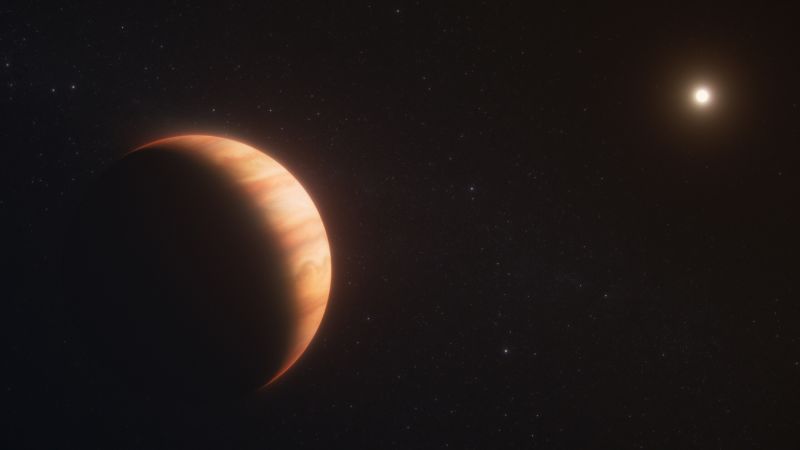
New observations may offer fresh clues into how a giant exoplanet survived the violent death of its host star — and came to closely orbit its stellar remnants.
Read more Americans now live longer in Democratic-held House districts. Here’s why
The findings could serve as a preview of the fate that may await our solar system’s largest planets — such as the gas giants Jupiter and Saturn — when the sun dies in 5 billion years.
Astronomers detected a baffling Jupiter-size planet in 2020 that was zipping around a dead white dwarf star. Located 80 light-years from our planet, WD 1856 b is seven times larger than its Earth-size star.
“This is one of the most bizarre planetary systems we know of,” said Dr. Christopher O’Connor, coauthor of a study published Wednesday in the journal Nature that detailed the observations. O’Connor is a postdoctoral fellow studying stellar and planetary astrophysics and dynamics at Northwestern University’s Center for Interdisciplinary Exploration and Research in Astrophysics.
‘The greatest cosmic movie ever made’: Historic telescope kicks off an unprecedented survey
WD 1856 b completes one orbit around the dead star every 34 hours and is less than 2 million miles (3 million kilometers) from its host.
When a massive sunlike star exhausts the hydrogen fuel at its core, it puffs up to more than 100 times its size before collapsing into a dense white dwarf. Given the close proximity of WD 1856 b to its star — 50 times closer than Earth is to our sun — astronomers were unsure how the planet survived its host’s destruction.
In order to retrace WD 1856 b’s unlikely journey of survival, O’Connor and his colleagues used the James Webb Space Telescope to capture the latest glimpses of the planet and measure its atmosphere, mass and temperature. Almost every finding the team made was unexpected — and suggested that huge planets can survive the demise of their host stars in ways previously thought impossible.
An oddball planet
The planet’s tight orbit and the lopsided relative sizes of WD 1856 b and its host star motivated O’Connor and his colleagues to investigate further.
“For a theoretical astrophysicist, finding a strange object located where it ‘shouldn’t be’ feels a bit like an invitation from the universe to get creative in search of an explanation,” O’Connor wrote in an email.
But making observations with Webb was challenging. The team had limited chances to watch a transit, or the dip in starlight as a planet passes in front of its star. Dead white dwarfs are much dimmer than the planet-hosting stars normally observed with Webb, said study coauthor Victoria Boehm, a graduate student in the department of astronomy at Cornell University.
“To make things even harder, the planet’s transit only lasts 8 minutes, so it’s very much if you blink you miss it,” Boehm said in a statement. “Capturing enough light to see WD 1856 b’s spectrum, while also doing so quickly enough to not miss the transit, is something only Webb can do.”
But the spectrum, or data captured as light from the star passed through the planet’s atmosphere, revealed previously unknown information about WD 1856 b.
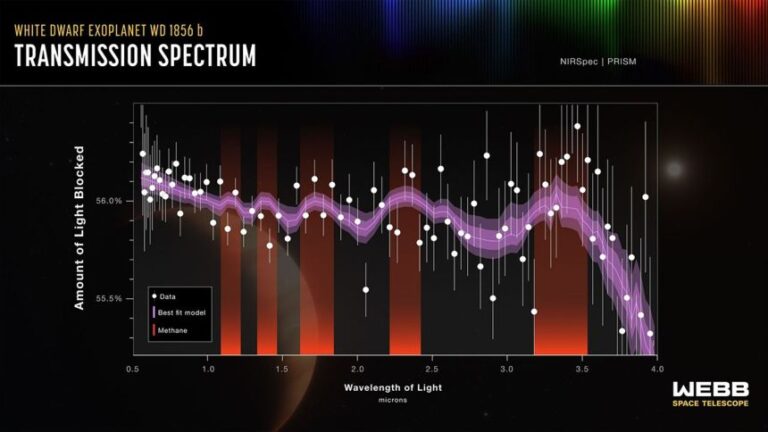
The team determined that the planet is between four and 11 times the mass of Jupiter.
Infrared light emitted by WD 1856 b suggested that it has a temperature of about 260 degrees Fahrenheit (127 degrees Celsius) — about 240 degrees hotter than if it were solely being heated by the dead star.
“That was really what started us on the track of figuring out the planet’s history from our data,” O’Connor said.
A curious migration
The team combined the new measurements with models of how giant planets like Jupiter and Saturn cool over time, which occurs at a predictable rate related to their mass.
The results showed that the planet originally orbited the star from a safer, much greater distance. But WD 1856 b heated up while migrating inward after the star died.
The researchers have two competing theories about how WD 1856 b ended up in its current, tight orbit.
Read more Former Olympic canoeist indicted by a grand jury after arrest at the Reflecting Pool
The “engulfment model” suggests that the planet was actually swallowed by the host star as it ballooned in size before dying but managed to survive, O’Connor said. The “gravitational interaction model” alternatively proposes that WD 1856 b avoided the star’s death throes, but the gravitational influence of other objects in the system pushed it closer to the white dwarf, he added.
“In either situation, there is reason to think that the planet would get heated up on the inside as a byproduct of the violent migration process,” O’Connor said. “In the first scenario, we would expect the migration and heating to have occurred simultaneously with the death of the host star, or about six billion years ago. In the second scenario, it can happen billions of years later, due to the chaos of gravitational interactions.”
The team’s data seems to indicate that heating of the planet occurred about 1 billion years ago, which might rule out the chances of engulfment — as does the Webb spectrum, which picked up on hints of the planet’s chemical composition.
“We saw the telltale signatures of small cloud particles and hydrocarbons, most likely methane, which is the first time we have seen an atmosphere on a planet transiting a dead star,” Boehm said. “We recently observed four more transits of WD 1856 b with Webb to take a deeper look into its atmospheric chemistry and can’t wait to see the results.”
Webb telescope photos show mysterious little red dots. Astronomers don’t know what they are
The abundance of methane adds another line of evidence that the planet didn’t go through engulfment during the red giant phase since that would have diluted the gas’ abundance as the planet accreted hydrogen from the star, said lead author Dr. Ryan MacDonald, lecturer in extrasolar planets at the University of St. Andrews in Scotland.
Dr. Caroline Morley, an associate professor in the department of astronomy at the University of Texas at Austin, said the discrepancies in inferred temperature results between the new study, which suggests the planet is quite warm, and previous research she coauthored, which identified the planet as much cooler, give her pause. Morley was not involved in the new study.
“There are reasons to be skeptical about the result that the planet was ‘reheated’ during stellar evolution,” Morley wrote in an email. “I do think that the tentative methane detection looks plausible, and the detection of clouds and/or hazes is solid. At this temperature, the best first guess for what ‘aerosols’ are present is water clouds, which form and become quite thick at these temperatures.”
While the detection of atmospheric methane was not surprising, the amount of the gas was higher than might be predicted, said Dr.
Ian Crossfield, an associate professor of physics and astronomy at the University of Kansas. Crossfield was not involved in the new study but was part of the team that discovered WD 1856 b in 2020.
“The conclusions about the planet’s migration to its present-day orbit are provocative, though more study is likely needed before firm conclusions can be drawn,” Crossfield wrote in an email. “The paper demonstrates how JWST’s most revealing planetary observations continue to be those of gas giants — analogues of our own Jupiter or Saturn — even when the star they orbit has died long ago.”
Modeling the fate of our solar system
The WD 1856 system acts like a preview for what could occur in our own solar system.
Like the host star of WD 1856 b, our sun will swell into a red giant in about 5 billion years, engulfing the closest planets like Mercury and Venus. Earth’s orbit places it right on the edge of this future “danger zone,” O’Connor said, so the fate of our planet remains unclear.
But rather than coming to a quick conclusion, the giant planets in our solar system may endure and continue to evolve for billions of years. The WD 1856 system is expected to remain in its current state for trillions of years, O’Connor noted.
Astronomers trace a ghostly cosmic particle to distant ‘Shadow Blaster’ galaxy
“Our results show that stellar death is not the end — some planets experience a vibrant and lively future after the death of their star,” MacDonald said.
As the sun transitions into a white dwarf about a billion years after the red giant stage ends, the rest of the planets in our solar system will continue to orbit the dead star.
“We expect the survivors to gradually drift away from the Sun until they reach about double their current orbital distances,” O’Connor wrote. “Perhaps, however, we should think about whether their orbits could change more dramatically, bringing one of them to migrate as close to the solar white dwarf as WD 1856 b is today.”
Sign up for CNN’s Wonder Theory science newsletter. Explore the universe with news on fascinating discoveries, scientific advancements and more.
Read more US service member arrested at Capitol after calling for Trump’s impeachment