 By admin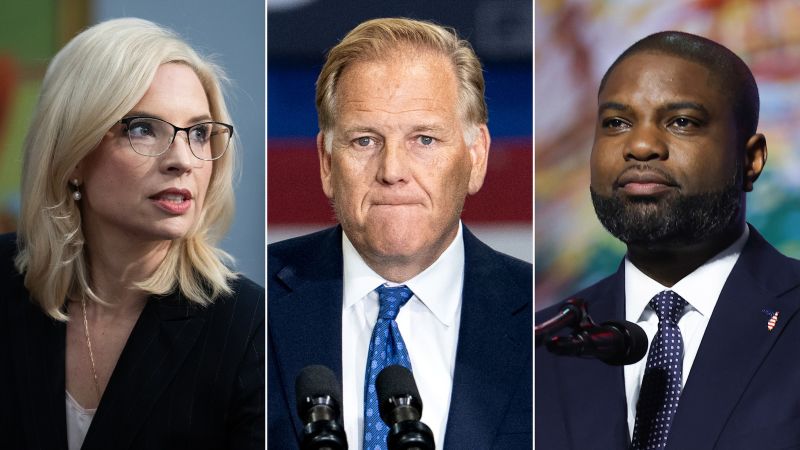
Republicans choosing to distance themselves from Donald Trump ahead of the midterm elections was somewhat inevitable, given how historically unpopular the president is.
Read more Trump administration says most refugees accepted in 2027 will be White South Africans
But the examples are piling up, and it’s notably happening in some pretty red territory.
Many of those running away from the president and policies like the Iran war are campaigning in territory that favored Trump by substantial margins — including by double digits in some areas.
The Iran war defections over the past week have been particularly notable.
Three of the big ones have come from one relatively small state: Iowa. Reps. Zach Nunn and Mariannette Miller-Meeks joined in a vote to limit Trump’s war powers last week. And on Monday, their colleague Rep. Ashley Hinson, who is the GOP nominee for Senate, posted on X that “the war needs to be brought to a successful and immediate end.”
Hinson’s defection came the same day that her fellow Midwestern Senate nominee, former Michigan Rep. Mike Rogers, released an ad similarly saying, “The war with Iran needs to end — and end quickly.”
Their moves come as new CNN polling on Tuesday showed just 26% of US adults approve of Trump’s handling of the war — a number that has gradually gotten worse.
That two Senate candidates broke with Trump on one day said a lot. But so did the fact that one of the states involved was Iowa, which Trump carried by 13 points in 2024.
(Trump won Nunn’s district by 5 points in 2024, and Miller-Meeks’ by 9.)
The road to the 2026 midterms starts now
- Each week, Aaron Blake cuts through the political noise with sharp analysis of the races, candidates and trends that could decide control of Congress. Sign up for 20/26 Vision, a weekly newsletter focusing on this year’s midterms.
There has been a sense that the state’s Senate race might be in play because Trump’s tariffs have hit Iowa particularly hard, and because Democrats recruited well with state Sen. Josh Turek.
And sure enough, the day after Hinson broke with Trump over Iran, a Marist College poll showed Turek leading by 8 points among registered voters — perhaps the most eyebrow-raising Senate poll to date, and one that suggests she has reason to be concerned.
But it’s not just Hinson who has felt compelled to distance herself somewhat from Trump despite running in an electorate that he won by double digits.
The Miami Herald reported Tuesday that Florida GOP gubernatorial nominee Rep. Byron Donalds, a loyal Trump ally, had scrubbed numerous prominent references to the president from his updated campaign website. Donalds also recently expressed “concerns” about Trump’s proposal to give every adult US citizen $5,000 if Republicans keep the House and Senate in November.
Donalds is running in a state Trump carried by 13 points.
And he’s not the only one who has made such changes to his website — despite running in deep-red territory. So too have California Rep. Young Kim (Trump +12), congressional candidates in Florida (Trump +11) and in Kentucky (Trump +15), and even Kentucky Rep. Andy Barr, who is running for Senate in a state Trump won by a whopping 32 points.
Another notable development on this front over the past week: A couple of GOP incumbents in heavily Hispanic — and double-digit Trump — congressional districts distancing themselves from the president’s hardline immigration policies.
In Florida, Rep. Maria Elvira Salazar told Trump in a direct-to-camera ad that some Hispanic voters “feel betrayed” by his immigration enforcement activities, saying they go “too far” by targeting those who hadn’t committed non-immigration crimes.
Asked about her ad last week, Trump said he did “disagree with her” but indicated he still backs her. Salazar said Sunday that she spoke with Trump, who was “very receptive” to her warning.
And in Texas, Rep. Monica De La Cruz touted her work to free a Deferred Action for Childhood Arrivals recipient who was being detained by Immigration and Customs Enforcement. The ad twice cited a “broken” immigration system.
Trump won Salazar’s district by 15 points and De La Cruz’s by 18 in 2024, when he did remarkably well among Hispanic voters for a Republican. But recent polls suggest that demographic has swung significantly back toward Democrats.
Many of these moves are relatively subtle, rather than full breaks from Trump.
Saying the Iran war needs to end isn’t the same as saying it was a mistake. The website changes are rather quiet — at least until reporters notice. And even in her immigration ad, Salazar speaks to Trump is if he’s just getting bad advice rather than delivering on the mass deportations that he repeatedly promised during the 2024 campaign.
But the fact that they feel the need to distance themselves in these ways — even in territory Trump won pretty easily in 2024 — speaks volumes about how they feel public opinion has shifted.
And they likely won’t be the last ones to do it. If anything, they might have just opened the floodgates for others who didn’t want to cross Trump but now might feel compelled to do so.
Read more Alexandria Ocasio-Cortez questions whether a Latina can be elected president