 By admin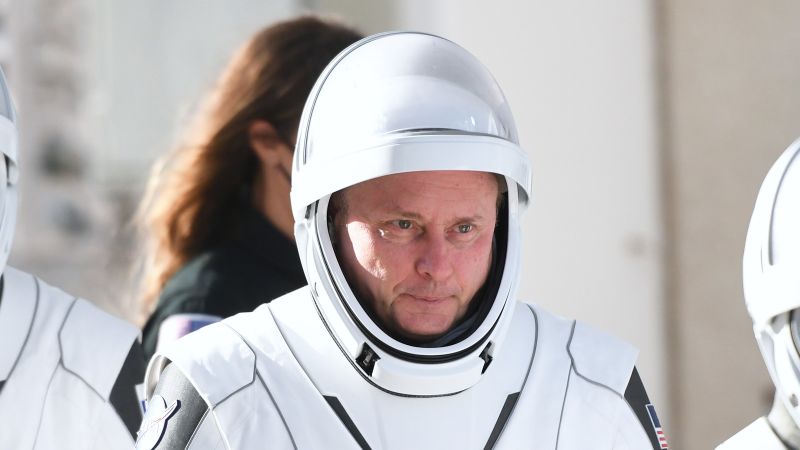
Longtime NASA astronaut Mike Fincke is stepping away from his role at the space agency. The news comes months after he experienced a medical emergency aboard the International Space Station, which forced a premature end to the journey for him and three crewmates.
Read more New details on Trump’s secret plane swap expose the administration’s lies
Fincke’s last day at the space agency is Wednesday, NASA said in a news release.
NASA reveals Artemis III crew that will take the next big step on its journey back to the moon
Although he is leaving NASA, Fincke said he remains “deeply committed to the work of exploration.”
“I am profoundly grateful to my crewmates, the teams on the ground, our international partners, and the families who make this work possible,” Fincke, who first joined the astronaut corps in 1996, said in a statement. “I am excited to carry those lessons forward and help prepare the next generation of engineers, explorers, and leaders. Together, we will return humanity to the Moon, travel to Mars, journey outward to the planets and moons beyond Earth, and someday reach for the stars – all while caring for Earth, the most beautiful planet in our solar system.”
Neither Fincke nor NASA provided details about what he plans to do next.
🚀 Get Countdown newsletter
- Sign up for updates from CNN Science on the upcoming total solar eclipse and whenever there’s a must-see, out-of-this-world expedition. Plus, take deep dives into the future of space exploration.
Over the course of his three-decade career, Fincke flew four missions to space, accumulating 549 days in orbit — the fourth highest among his NASA colleagues — and completed nine spacewalks.
The vast majority of his days in space were spent aboard the football-field-size ISS. His last stay at the orbital outpost garnered global attention when Fincke was overcome with a mysterious ailment, losing the ability to speak for roughly 20 minutes, Fincke later told news outlets, including the AP.
The ordeal prompted an urgent response from NASA. Fincke and his fellow SpaceX Crew-11 astronauts — NASA astronaut Zena Cardman, Kimiya Yui of the Japan Aerospace Exploration Agency, and cosmonaut Oleg Platonov of the Russian space agency, Roscosmos — returned home from the space station in mid-January, weeks earlier than expected.
The group’s sudden departure marked the first time in history NASA had to cut short an ISS staffing mission for health reasons. At the time, the space agency did not disclose which astronaut had the medical concern or reveal the nature of the issue, prompting a wave of speculation.
Read more Exclusive: Former Southern Poverty Law Center CFO arrested on fraud charges
Typically, NASA does not share details of medical emergencies or name the astronaut involved to protect their privacy, but Fincke identified himself weeks after the incident.
In an interview with AP, Fincke said that the medical event remains a mystery that NASA and medical researchers are working to solve. His lost ability to speak did not feel like choking, Fincke said, but his crewmates “definitely saw that I was in distress” and responded quickly. “It was all hands on deck within just a matter of seconds.”

CNN Flashdoc: Eclipsing power: Musk, Bezos and the new space race
NASA had said during the crew’s journey home that the affected astronaut was in stable condition. And Fincke noted in a February statement that the agency had determined the crew should return to Earth to take advantage of “advanced medical imaging not available on the space station.”
The ISS is stocked with medical equipment, though it does not have all the tools typical of an emergency room.
The unexpected medical problem set off a rapid series of events as NASA canceled a planned spacewalk, quickly scheduled the group’s return trip, and then worked to speed up the launch of the space agency’s next staffing mission to the orbiting outpost.
The departure of Fincke and his Crew-11 teammates left the station briefly staffed with only three astronauts.
A group of four astronauts, referred to as Crew-12, arrived at the space station on February 14 , brining staffing levels back up to seven people — the number NASA typically desires to keep scientific experiments and other duties on track.