 By admin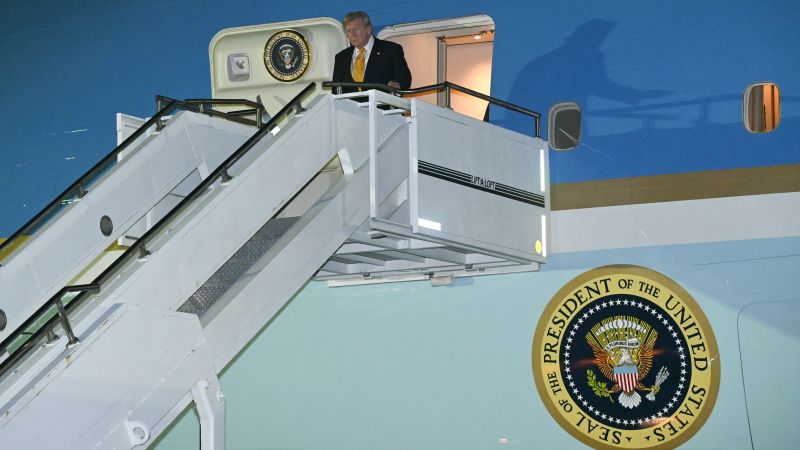
On its surface, the news that President Donald Trump secretly switched planes before departing Turkey last month because of a security threat from Iran might seem non-controversial — and even kind of cool, in a cloak-and-dagger sort of way.
Read more AOC joins the growing number of women freezing their eggs. Here’s what to know
But the story — which was broken by the Washington Post late Monday and later confirmed by CNN and others — does raise some very real issues and questions.
First, let’s recap the basics of the reporting.
It was already reported last month that, due to security concerns, the White House had scrapped a return flight on the new Qatari-gifted plane that Trump uses as Air Force One in favor of the older plane. (Trump had initially claimed it was so US service members could tour the new plane.) The old plane has better security features than the retrofitted, new plane. And given Turkey borders Iran, that precaution would make sense.
It’s now clear that Trump boarded the legacy plane, then was secretly transferred via a catering truck to a smaller Air Force C-32A. He flew that to UK, where he kept up the ruse by covertly re-boarding the old Air Force One, deplaning for cameras and then got on the Qatari-gifted plane for the return flight home.
That brings up the first issue.
Trump and the White House lied — even after the threat had ostensibly passed
It’s legitimate — and not-unheard-of — for these kinds of measures to be taken to protect a president. But it’s notable that Trump and the White House kept lying about it even after the apparent danger had passed.
Then-President Bill Clinton used a decoy plane for a trip to Pakistan in 2000, arriving in an unmarked C-20 after a more conspicuously American-branded C-20 had landed. (US officials feared Clinton’s plane might be shot down by terrorists like Osama bin Laden.)
But Clinton soon got off the unmarked plane, effectively disclosing the ruse to the public. And the Washington Post reported Tuesday that the Clinton White House briefed the head of the White House Correspondents’ Association, off the record, ahead of time.
In contrast, Trump and the White House went on pretending like he had actually flown on the legacy Air Force One.
During a gaggle on the later leg from the UK back to the United States (when Trump was on the new plane), the president spoke broadly about the possibility that the plane could have faced security concerns. But he flatly denied there was a specific one.
“You’re saying there wasn’t a security concern?” a reporter asked.
“No. No. Why would there be?” Trump responded.
Asked if there were “any other issue,” he said: “No.”
When reporters kept pressing on whether there was a specific threat, Trump repeatedly deflected.
“Well, I have a threat all the time,” Trump said. “I’m number one on their list before you. But if I go, you go.”
A Democratic national security aide said Tuesday that the Gang of Eight, a group of congressional leaders, was not briefed on the episode, but noted that presidential movements are not something Congress gets deeply involved in managing. But, the aide added, “Congress should have been briefed on the threat if not the episode.”
A Republican aide to a member of the Gang of Eight said they could not comment on actions of the group.
The plan used reporters and staff as decoys — and seemingly put them in danger
And that gets at another dicey piece of this. While it’s understandable to take extensive measures to protect the president, this plan left many people — including reporters and administration staffers — on the legacy Air Force One as unwitting and unknowing decoys very much in the line of fire.
The questions from there are: Was there any alternative to that, such as allowing everyone else to fly out on other airplanes? Why were reporters not informed? (Sometimes such information can be shared on an embargoed basis, in which reporters have the information but can’t publish it. Of course, the Trump administration doesn’t trust the press.) And lastly, what precautions were taken to protect the legacy plane?
Read more Civil rights groups ask judge to block Trump’s new birthright citizenship order
“There’s going to be questions now with respect to what security was provided for each of the other two 747s, where people were still flying on that plane representing the United States press, White House staff,” former Secret Service agent Robert McDonald said on CNN’s “The Story Is with Elex Michaelson.”
Secretary of State Marco Rubio on Tuesday ignored a question from CNN about whether the administration put reporters and staff at risk.
It sharply undercuts Trump’s claims of Iran’s weakness (again)
While there’s still a lot that’s not publicly known about the specific threat from Iran, the fact that it was apparently credible enough for this switcheroo sharply undercuts Trump’s claims that Iran’s military capabilities have been decimated.
Trump has not only claimed this, but he and Defense Secretary Pete Hegseth have specifically cited Iran’s purported inability to shoot down aircraft.
Hegseth said back in March that the United States and Israel would soon have “complete control of Iranian skies” and “uncontested airspace.”
“We literally have planes flying over Tehran and other parts of their country; they can’t do a thing about it,” Trump added March 24.
Trump also said that Iran had “no navy,” “no military,” “no air force” and “no anti-aircraft systems.”
Of course, shortly after all of these comments, Iran in early April managed to shoot down two US jets. But the idea that it could plausibly take down Air Force One even more sharply undercuts Trump’s claims.
“If they needed to take such extraordinary steps to protect the president because the threat level was so high, the American people deserved to know that the threat level was that high in this particular case,” former Obama White House adviser David Axelrod said Monday on CNN’s “The Source with Kaitlan Collins.”
It prompts more questions about Air Force One and the controversial reporter subpoenas
On a broader level, this development thickens the plot on an already confusing saga involving Air Force One, security concerns and the White House’s efforts to tamp down that story — including by issuing controversial subpoenas to New York Times reporters.
There were already valid questions about the initial decision to not let Trump fly his Qatari-gifted plane back from Turkey. If the plane wasn’t as safe as the legacy plane, why was Trump flying it at all, particularly in foreign airspace? It suggested Trump’s desire to get the coveted new plane in the air might have led to cut corners (which is a theme with him).
Then the administration took the extraordinary step of subpoenaing the Times journalists who had reported that that Qatari-gifted jet was swapped out for security concerns. It claimed the situation involved someone “threatening national security by leaking classified information.” But the administration withdrew the subpoenas two weeks later, after a judge made clear he was skeptical about its argument.
CNN has also reported that there has been a sprawling internal investigation inside the administration, with some officials being asked to turn over their phones.
The story surely involves national security issues. But how much of this effort to root out leakers is also about avoiding embarrassment associated with Trump’s hasty and potentially dangerous decision to insist on flying his Qatari-gifted airplane? Or, potentially, about avoiding disclosing having used staffers and reporters as decoys?
Read more Taylor Farms recalls jalapeño products due to salmonella risk
Or maybe Trump just didn’t want to admit Iran had such capabilities.