 By admin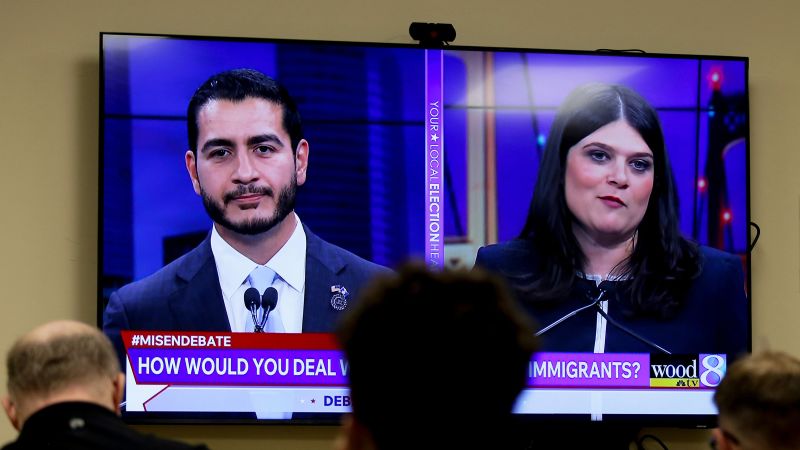
Fiercely fought primaries on August 4 in Michigan and Missouri will provide the next crucial tests in the debate over American policy toward Israel that has convulsed the Democratic Party this year.
Read more Massachusetts Democratic Senate primary sets up a battle of generations
Arguments about Israel have marked a sharp dividing line in both the Michigan Senate primary between centrist Rep. Haley Stevens and progressive Abdul El-Sayed, and a Missouri rematch between firebrand former US Rep. Cori Bush and Rep. Wesley Bell, a more mainstream figure, who ousted her in a primary two years ago. While Stevens and Bell largely defend the existing US security partnership with Israel, El-Sayed and Bush denounce it.
For years, critics of Israel like Bush and El-Sayed were largely marginalized in the Democratic Party. But the party’s primaries this year have demonstrated an explosion of frustration among rank-and-file Democratic voters over Israel’s actions in Gaza, the West Bank and elsewhere under long-time Prime Minister Benjamin Netanyahu — and the refusal of former President Joe Biden to more forcefully confront him while in office.
The intensity of that backlash has rapidly reset the terms of the Democratic debate over Israel. Only two years ago, Democratic presidential nominee Kamala Harris refused to allow a pro-Palestinian activist to speak from the podium at the party’s national convention. Today, Democrats are debating not whether, but how extensively, to reconfigure American policy toward Israel and the Palestinians.
“The change is seismic,” says Jeremy Ben-Ami, president of J Street, a group that supports Israel but often criticizes its right-leaning leadership. “This is an unbelievably fast shift. We are witnessing in real time a total remake of the politics of the Israel relationship.”
Results in Democratic primaries this year so far show a split decision, with progressive candidates deeply critical of Israel advancing mostly in safe blue districts, and centrists who would preserve more of the traditional relationship prevailing in most swing districts and states that will decide control of Congress.
The Michigan race early next month is attracting so much attention precisely because an El-Sayed victory would represent the most consequential win so far for an Israel critic in a race that will be competitive in November. The irony is that for all the time the candidates, activists and the media are devoting to Israel and the role in these contests of the American Israel Public Affairs Committee, its principal US defender, pollsters working in both Michigan and Missouri believe voters are focusing mostly on other concerns as they make their choices.
A sharp drop in US support for Israel

The rising attention to Israel in Democratic primaries this year is directly related to the precipitous decline in the nation’s image with the American public since its ferocious response to the October 7, 2023 Hamas terrorist attack. In polling by the Gallup Organization, the share of Americans who expressed a favorable view of Israel plummeted from 75% in 2021 to 46% in 2026.
That 29-percentage point decline is comparable to some of the greatest collapses in American attitudes toward any foreign nation in modern times. Earlier Gallup polls found, for instance, that the share of Americans who viewed Russia favorably fell by 27 points starting in 2011 and continuing through the invasion of Crimea in 2014.
The erosion of Israel’s image following the Gaza war is hardly unique to the US. Polling this spring from the Pew Research Center found a similar decay in Israel’s standing in virtually every Western democracy. “It is a historic failure by Netanyahu, the way he has left Israel isolated from what were once its closest allies,” says Matthew Miller, the press spokesperson for the State Department under Biden. “The long-term ramifications for Israel’s security are really going to be incredible.”
No group in the US has been entirely immune from this shift. In recent domestic Pew Research Center polling, White Evangelical Christians were the only major religious denomination in which a majority expressed a favorable view of the Israeli government; that three-fifths of American Jews view Netanyahu unfavorably. This current is reshaping Republican attitudes too: in the Gallup surveys the share of Republicans expressing a favorable view toward Israel has fallen substantially in recent years, as has the share who view the Israel government favorably in Pew’s polling. But in both cases, Israel still maintains majority support among Republicans (though younger GOP partisans are much more skeptical than older ones.)
Israel’s position is much more precarious among Democrats. In the Gallup surveys, just one-third of Democrats express a favorable view of Israel; in recent Pew Research Center polling just one-sixth of Democrats viewed the Israeli government favorably. In one recent national poll, only 5% of Democratic voters expressed favorable views about Netanyahu, who has openly tilted toward the GOP over his long career.
Progressive candidates who describe Israel’s actions in Gaza as genocide and propose to severely retrench American support for the Jewish state have won Democratic House primaries this year in New York, New Jersey, Pennsylvania and Colorado, among other places.
“Based on the many polls we have run since 2024, the Democratic electorate hates what happened in Gaza,” says Alvin Tillery, a Democratic pollster who worked for Chris Rabb, a left-leaning Israel critic who won a crowded Pennsylvania House primary earlier this year. “Indeed, they are much closer to the [Senators] Bernie Sanders/Chris Van Hollen position — that American taxpayers should not fund it — than they are to the position that Biden and Harris maintained in the 2024 cycle.”
But candidates who resist the genocide label and defend the basic contours of the US security relationship with Israel-even as they typically criticize its actions in Gaza and the West Bank-have won many contested nomination fights in more politically competitive districts. Israel has only rarely been a central issue in those broader confrontations between centrist and progressive candidates. But the success of centrist House nominees generally friendly to Israel such as Cait Conley in New York, Paige Cognetti in Pennsylvania, Greg Stanton in Arizona, and Christina Bohannan in Iowa disprove any notion that support for the nation has become untenable in the party.
“It’s obviously a difficult moment right now,” says Brian Romick, president of Democratic Majority for Israel, a centrist pro-Israeli group. But the idea that supporters of Israel are no longer viable in the party, he says, “is both wishful thinking and overstated on the left.”
Heated rematch in Missouri
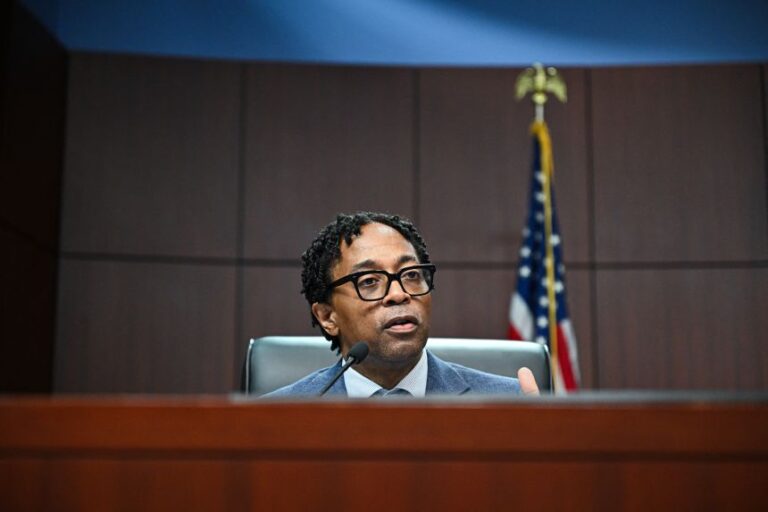
The primary between Bell and Bush next month will mark the next big test in these House contests. Bush, a grassroots activist, and Bell, at the time a city council member, both emerged from the protests that engulfed Ferguson, Missouri, after the shooting of Michael Brown, a young black man, in 2014. Bell unseated a long-time White incumbent to win election as the St. Louis County prosecutor in 2018; two years later, Bush ousted a Black incumbent and then won election to the US House.
Read more The US military hasn’t blown up an alleged drug boat in a month. Has the campaign worked?
In the House, Bush allied closely with the “Squad” of left-wing legislators and pursued a confrontational approach toward both Republicans and her own party leadership while emerging as one of Israel’s fiercest critics. Bell, a more buttoned-down politician, challenged and beat her in a 2024 primary-with support from more than $8 million in AIPAC spending-and then easily won election in November. Now she’s challenging him for her old seat.
In the rematch, Bush has continued to sharply criticize Israel and AIPAC’s spending for Bell. (According to AdImpact data, AIPAC’s principal political action committee, the United Democracy Project, has spent over $1.5 million on ads to support Bell.) Bell has said he is “not a fan” of Netanyahu but resolutely defends the core security relationship with Israel
Tef Poe, a hip-hop artist and community activist in St. Louis, says he views the race as “a real dogfight.” Poe, co-founder of the group Formation Through Power, believes the fundamental dividing line in the contest is that voters who feel the most alienated from the political and economic system are gravitating to Bush, while Bell attracts mostly people “who are more working-class homeowners, who kind of have some gleam of what the establishment is supposed to look like, sound like, feel like.”
And while Poe, like others closely watching the race, says that Israel and Gaza are not the primary issues for voters facing so many daily economic challenges, he believes AIPAC’s heavy spending for Bell still rankles many. “People are tired (of) hearing about AIPAC from Cori Bush,” says Poe, who is supporting her in the race. But, at the same time, he says, the group’s work for Bell has voters asking, “Why are we talking about Israel so much in adjacency to this man?”

Besides AIPAC’s big spending, Bush’s other biggest hurdle is the district’s make-up. While she is strong in lower-income largely African American precincts in St. Louis city, the district includes mostly White and more affluent suburban areas in St. Louis County. And while well-educated White Democrats have flocked to several of the far-left candidates most critical of Israel in urban centers such as New York and Denver, it’s less likely that suburban Whites in Missouri will follow their tracks. Bush’s “structural problem” is that while she will likely win the city part of the district, “it’s not going to be enough to offset the much larger county vote,” says Kenneth Warren, a St. Louis University political scientist.
Terrance Woodbury, a Democratic strategist who focuses on younger voters of color, agrees that not many primary voters consider Israel and Gaza a top voting issue. But he still believes criticizing US deference toward Israel-and even more so, AIPAC’s spending in Democratic primaries-has become a powerful way for candidates to tap into voter discontent with the party establishment.
“Progressives are using Israel and specifically AIPAC to drive home the point of a rigged system where money and special interests have too much control over our outcomes,” Woodbury said. “It does create a unique target for progressives who say ‘they (the establishment) can’t be trusted in a rigged system.’ It’s not a top issue; but it’s a defining issue.”
Pro-Israel money pours into Michigan
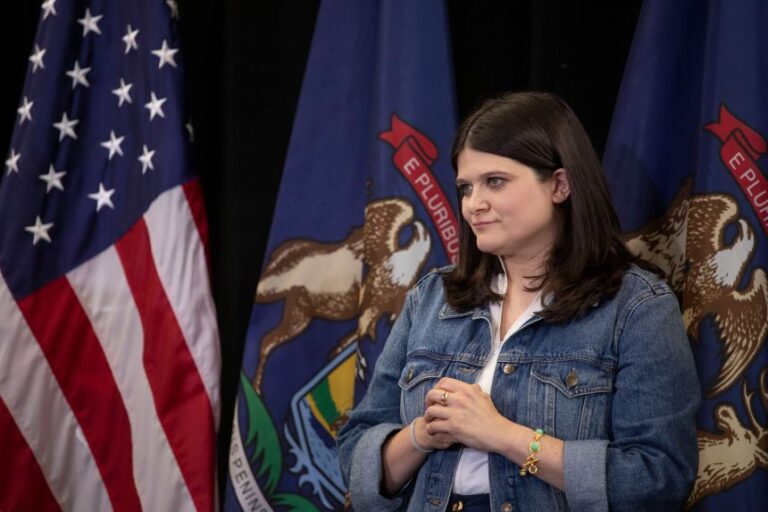
The Michigan Senate primary will test the power of that strategy. El-Sayed, a charismatic campaigner, vehemently denounces Israel as a “rogue state” practicing “genocide and apartheid”, has repeatedly sidestepped questions on whether he supports its right to exist, and calls for not only ending the $3.8 billion in annual US military aid but also blocking further sales of American weapons. Stevens has criticized Netanyahu but rejects both of those policy changes, expresses traditional Democratic support for a two-state solution, and has unequivocally defended the alliance.
But when the candidates met for a debate earlier this month, El-Sayed focused less on policy toward Israel than on AIPAC’s heavy spending for Stevens (which AdImpact now calculates has reached nearly $30 million, mostly on ads touting her work for President Barack Obama’s auto bailout effort). He framed AIPAC’s spending as emblematic of a political system rigged against average families.
Local analysts believe that populist message is resonating for El-Sayed most powerfully with younger, ideologically liberal, and college-educated voters and not the older, minority and working-class voters it ostensibly targets. That’s the same pattern evident for many of the other left candidates this year. Michigan Democrats are divided on whether the coalition behind El-Sayed, who has led in some polls, will turn out as reliably as Stevens’ contrasting voter base of older, Black, and working-class White voters. El-Sayed will also benefit from Michigan’s large Arab American population, but if Haley can generate robust Black turnout in Detroit, the odds will tilt toward her. Stevens also received a boost late Friday afternoon when popular Gov. Gretchen Whitmer endorsed her.
“The short version is I’d rather be Haley than Abdul right now,” says Adrian Hemond, a long-time Michigan Democratic consultant. “The reason is she has an easier winning coalition to hit than he does. Seniors and Black voters in a statewide Democratic primary are two of your most reliable voting demographics. Whereas Abdul has a harder job: he has to get out (younger) people who are not normally inclined to vote in a primary election.”
But just as many over interpreted the wins by three anti-Israel left candidates in New York City primaries last month, it would be mistaken to assume that even victories by Stevens and Bell signal that skepticism of Israel has peaked within the party. About half of House Democrats this month voted to terminate all military and civilian aid to Israel, an unimaginable outcome even under Biden. Former Chicago Mayor and likely 2028 presidential contender Rahm Emanuel this month endorsed an end to US military aid during a speech in Israel.

With even Netanyahu agreeing that US financing for the Israeli military should phase out, “that ultimately may be where we end up,” Romick acknowledges. But Miller says that’s likely to become the minimum acceptable position for the 2028 Democratic presidential candidates.
While an aid cutoff was confined to the fringe a few years ago, now it “won’t go far enough for many in the party,” says Miller. “And I think there is going to be a push for candidates who will say the campaign in Gaza was a genocide and to enact a full arms embargo and even to enact sanctions on the country.”
Ben-Ami of J Street says the “Israel right or wrong” consensus that dominated the party for years has clearly collapsed, but the “Israel is always wrong” view emerging on the left lacks enough support to replace it. “You’ve got loud voices that are going to be all the way to one end of the spectrum, but 70 or 80% of the party … falls in a nuanced middle that seeks balance and wants to meet the needs of both (the Israeli and Palestinian) people,” Ben-Ami said.
He may be correct. But, if this year’s primaries are any guide, reconciling these diverging views may divide Democrats more bitterly than any other issue over the next few years in Congress-and the race for the party’s next presidential nomination.
Read more ‘Going it alone does not work’: America’s first one-party war
CNN’s David Wright contributed to this report.