 By admin
- DOJ files reveal Mount Sinai Hospital gave Jeffrey Epstein VIP treatment even after his conviction.
- A plastic surgeon from the hospital made house calls to Epstein’s home.
- The hospital has said little publicly to address the controversy.
For Dr. Ira Bleiweiss, a renowned breast pathologist who sees upwards of a thousand breast cancer cases in a typical year, the email he received in July 2014 felt hardly out of the ordinary: The founder of the Dubin Breast Center at Manhattan’s Mount Sinai Hospital wanted to connect him with the daughter of a breast cancer patient for an urgent consultation about her mother’s case.
Read more Landmark regulations against ‘forever’ toxins removed by Trump administration
“She is receiving the specimen tomorrow and can bring it up to you. I will let two of you take it from here,” Eva Andersson-Dubin .
More than a decade later, Bleiweiss was shocked to learn that his name was mentioned in the Justice Department’s Epstein files numerous times. Unbeknownst to him, the patient’s daughter, Karyna Shuliak, had been Jeffrey Epstein’s girlfriend at the time. And Andersson-Dubin — a doctor and former Miss Sweden married to American hedge fund manager Glenn Dubin — was Epstein’s ex-girlfriend.
In a recent interview with CNN, Bleiweiss said he vaguely remembered Andersson-Dubin introducing him to the daughter of a patient who was from Eastern Europe. He knew nothing about Mount Sinai’s links to Epstein while he worked there, he said, and was shocked to learn about them years after his affiliation with the hospital ended.
“People were doing literally their jobs and the best they could to take care of people. How would they? They would have no idea,” said Bleiweiss, who now works at the University of Pennsylvania.
Bleiweiss’s brief, unsuspecting run-in with a segment of Epstein’s world in 2014 – years after Epstein was convicted of soliciting prostitution from a minor — is one of many examples of how the convicted sex offender used his connections at Mount Sinai for his personal benefit.
The DOJ’s release of millions of Epstein files in recent months has newly exposed the lengths to which a handful of individuals went to give the financier VIP treatment at Mount Sinai – doctors being at Epstein’s beck-and-call, including for house calls, and giving preferential treatment to Epstein’s friends for medical care and job prospects.
The revelations mark a moment of reckoning for Mount Sinai Hospital, a prestigious medical institution in New York City backed by the donations and clout of some of the country’s wealthiest and most influential names. The hospital has reportedly formed a committee to look into its ties to Epstein, but has publicly — and internally to the Mount Sinai community — said little to address the controversy. Meanwhile, Mount Sinai’s breast center, founded with the Dubins’ donation, still bears their name, while some of the doctors who gave Epstein medical care still work at the hospital.
Epstein’s treatment by Mount Sinai — even after he was a registered sex offender — offers a window into the world of medicine for the most elite, where wealthy and well-connected patients can pay to get special treatment and access. It also exemplifies how institutions that heavily rely on and solicit donations can be riddled with conflicts of interest, with donors and financial considerations having influence on an institution’s decision-making.
Lucia Lee, vice president of public affairs at Mount Sinai, shared a statement from a spokesperson that said: “Epstein’s actions are horrific, reprehensible, and stand in direct opposition to what Mount Sinai believes in and stands for as an institution and as medical professionals.
“Our patients will always be treated with the highest level of care and respect,” the spokesperson said. “We do not comment on the clinical care provided to individual patients.”
The statement did not address numerous questions from CNN, including about the status of Mount Sinai’s internal investigation into its Epstein ties, the hospital’s accounting of how much money it received from Epstein, Mount Sinai’s VIP treatment of Epstein and Ting and Solomon’s conduct.
Multiple medical professionals affiliated with the hospital told CNN that there has been no communication from the institution’s leadership to the broader community about how it is handling its past ties to Epstein. Many employees fear that speaking out about the matter could hurt their careers, they said.
“These ties should be cut; those doctors that are implicated should be fired; we should rename Dubin Breast Center. I think most people working at Mount Sinai are like on the same page there, and it’s really the upper leadership that’s not,” said one doctor affiliated with the hospital who also attended the Icahn School of Medicine at Mount Sinai, speaking anonymously because of fear of retribution.
“I think they’re just focused on the money and not upsetting people in power, because even if Epstein’s gone, there’s still so many other people in power that were (associated with) him that can do damage to probably Mount Sinai’s funding stream,” the doctor said.
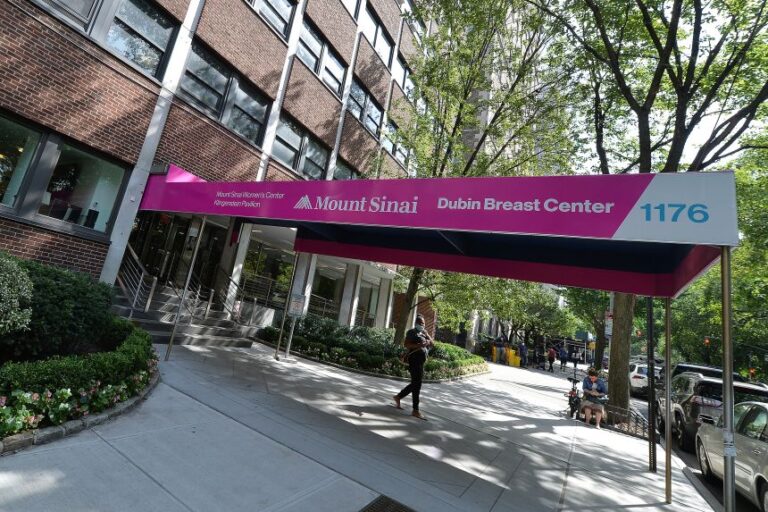
One former Mount Sinai doctor who worked at the Dubin Breast Center told CNN he was also unaware of Epstein — let alone his connections to the hospital — until recently. “Literally I had no knowledge. I’m shocked,” he said. “Whatever is appropriate, not for the institution but appropriate for the patients in the community that are served by this institution — I hope that Board of Trustees do whatever that is right.”
CNN reached out to several dozen current and former board members of Mount Sinai — none were willing to speak.
Special treatment and house calls
The release of the Epstein files has further raised questions about the Dubin family’s close ties to Epstein. Eva and Glenn’s daughter, Celina, was once listed as a beneficiary in an Epstein trust, and Epstein referred to her as his goddaughter. She did her dermatology residency at Mount Sinai. (A family spokesperson told the New York Post that Celina was “unaware that she was named in any Epstein trust” and upon finding out, signed a renunciation and disclaimer form that was submitted to the Epstein estate.) Glenn Dubin also appears in the Epstein files, exchanging friendly banter or discussing business endeavors with Epstein.
Eva Andersson-Dubin — who in 2009 to Epstein’s probation officer she was “100% comfortable with Jeffrey Epstein around my children” after he was convicted of soliciting prostitution from a minor — appears to have played a significant role in ensuring that Epstein’s needs were met with urgency and deference at Mount Sinai, the files show.
In 2013, Andersson-Dubin to Robin Solomon — who was then head of trustee services for the hospital — to say that Epstein had gone to Mount Sinai’s emergency room in the middle of the night but was unable to reach his doctors. Epstein ended up going to Lenox Hill, another hospital in the city, and “in the future I told him I would like him to go to Sinai,” Andersson-Dubin said.
“My question is, if it is in the middle of the night is there any way to make the ER a smooth experience? Anyone he should call besides his doctors?” Andersson-Dubin Solomon.
Solomon wrote back with a phone number that she said was “covered 24/7 by a member of my team.” “All he has to say is he’s a friend of yours and EVERYONE is great,” she .
One doctor, the files show, appeared particularly attuned to Epstein’s “VIP” status: Jess Ting, a plastic surgeon at Mount Sinai. As with his colleagues about arranging MRI scans for Epstein in 2013, he emphasized: “The patient is a VIP and we need to make this happen. Let me know if there are any roadblocks.”
Ting’s interactions with Epstein were not limited to the confines of the hospital; the files show multiple mentions of Ting going to Epstein’s house in New York City for in-person visits as well as a visit to his private island in the Caribbean.
“Hello Dr. Ting. I hope you had a nice visit to Jeffrey’s island last Friday. Jeffrey is asking if you could come see him at his home on April 2, 3 or 4 after 5pm,” Epstein’s assistant to Ting in March of 2013. When Ting suggested that he could be there around 7:30 in the evening, the assistant wrote back: “Jeffrey is asking if you could come at 10pm instead?”
“yes. See you then,” Ting .
At the end of that same year, Ting agreed to head over to Epstein’s home to remove a “small fat cyst” from his upper shoulder. But the arrangement appeared to draw the ire of the head of Ting’s department, according to an email Ting wrote to Epstein’s assistant.
“Also the dept chairman found out I was planning to do the excision today at the patient’s home,” Ting , “and said if I did it there I would be sanctioned. Ridiculous!”
In 2016, Ting corresponded with Epstein’s assistant Lesley Groff about another house visit — but this time, he wanted to bring along another medical expert. “I would like to bring my brother with me – he is a vascular surgeon at Mount Sinai. The reason is because the tumor is directly adjacent to the subclavian vessels and it would be safer to have a vascular surgeon involved – just in case,” he .
When a reporter with Reuters reached out to Ting in 2015 asking to speak with him about Epstein’s philanthropic work, Ting promptly forwarded the request to Epstein’s assistant. Groff : “Jeffrey actually says to YES respond!”
Ting that he would forward his answers to the reporters’ questions “so Mr. Epstein can vet my responses.” It’s not clear whether Ting was ultimately interviewed.
Ting did not respond to CNN’s request for an interview for this story and did not respond to a list of questions. Andersson-Dubin and Robin Solomon did not respond to CNN’s request for comment.
‘For Mr. Epstein anything is possible’
It’s not clear whether Epstein ever used his Mount Sinai connections to obtain medical care for the women he was abusing. But one Epstein survivor, Dani Bensky, told CNN last month that when her mother was diagnosed with a brain tumor, Epstein had told her “that all it would take was one phone call to Mount Sinai to get her the top of the line care.” (Lee, Mount Sinai’s spokeswoman, did not respond to CNN’s previous requests for comment about Bensky’s account; Bensky said she has no knowledge of Epstein ultimately helping with her mother’s care.)
The files do show that Mount Sinai’s VIP treatment extended to those in Epstein’s circle. In October 2012, Epstein alerted Andersson-Dubin via email that he was about to land in New York, and that a redacted person had fallen off an ATV and needed stitches in her forehead and an X-ray.
“OK Jess ting is standing by. Call me as soon as you land,” Andersson-Dubin responded, offering to go with Epstein.
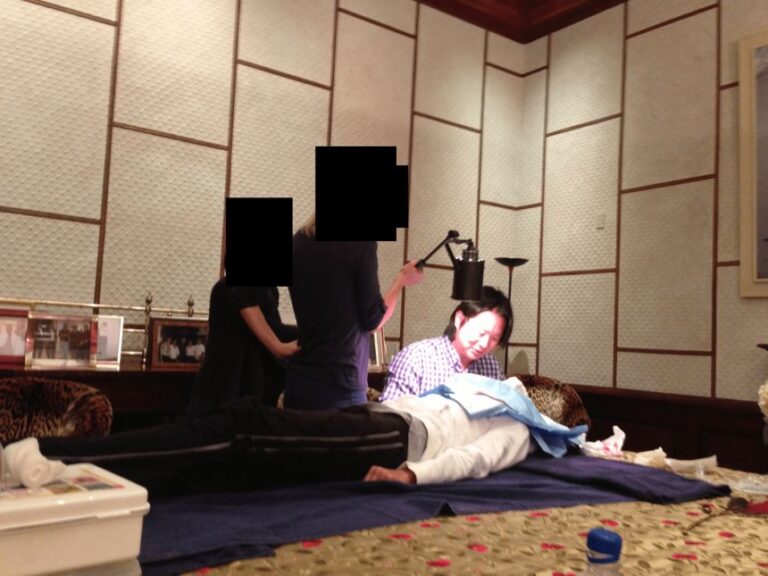
In addition, an undated in the Epstein files shows Ting inside of Epstein’s home standing over a patient, whose face is not visible, lying on a table. Two others are standing by – their faces are also redacted.
In May of 2013, Ting agreed to stop by Epstein’s home to look at the nose of a “a very good friend” of Epstein’s. But when a scheduling snafu made Ting realize that his initial appointment time would conflict with picking up his three “young kids,” Epstein’s assistant insisted that was no problem, to Ting: “Jeffrey says it is just fine to bring the kiddos!”
When an assistant to Epstein emailed Ting in December 2014 asking whether he could see Epstein’s friend to “fix a hole in her nose from a nose ring,” the surgeon that he would soon be on vacation for two weeks. “BUT,” Ting said, “for Mr Epstein anything is possible.”
That same year, Epstein had several preoccupations related to Mount Sinai – but they had nothing to do with his health. For one, his girlfriend, Shuliak, was applying for a dental residency at the hospital and it was her first choice. He : “any help would be greatly appreciated.”
Several weeks later, when Shuliak was informed that she had not been selected for an interview, Epstein forwarded the rejection email to Solomon. Solomon complained about not getting Shuliak’s application information sooner but she was still trying to help: “I’m going to call my contact tomorrow and get her interviewed.”
It’s unclear whether Shuliak was ever interviewed.
Epstein was also concerned that year about helping to secure a visa for Shuliak’s mother. He appears to have suggested language for the hospital to use requesting a “medical visa” for her, and the files include on Mount Sinai’s letterhead addressed to the US Embassy in Belarus. It is not clear whether Shuliak’s mother obtained a visa.
Six-figure donations
Mount Sinai has not publicly disclosed how much money it received from Epstein. In 2019, weeks after Epstein died in jail, the hospital said in a press release that Epstein’s “reprehensible behavior is completely antithetical to these values” and that it would contribute “a sum equal to the donations we received from Mr. Epstein and his foundation” to a charity.
The Epstein that the New York financier appears to have given over $300,000 to Mount Sinai-affiliated organizations, with at least $125,000 donated directly to the Dubin Breast Center.
In 2013, Andersson-Dubin tried to pitch Epstein on helping to fund post-surgery recovery rooms for women, telling him that the floor could be called “The Epstein Floor for Women.” The next year, hospital employees discussed putting up a plaque at the Dubin Breast Center that it was in honor of Epstein. It is not clear if this plaque ever went up.
Documents that Epstein helped fund a room inside of the exclusive “11 West” building at Mount Sinai that caters to wealthy patients, with Andersson-Dubin telling Epstein in 2015 that his room was mostly finished.
Epstein also lavished individuals at the hospital with gifts. In 2014, he directed someone to purchase an $8,000 white fur coat for Solomon, while in 2018, Epstein Shuliak to purchase a Ralph Lauren cashmere sweater for a Mount Sinai employee whom Andersson-Dubin as the “head of VIP for the hospital.”
Epstein also donated a white hand-painted and to the hospital. It’s unclear whether they are still at Mount Sinai.
Read more Buyer beware of sunscreens: New report finds few meet safety standards