 By admin
- Harrison Browne became the first openly transgender athlete in professional team sports when he came out in 2016.
- Research shows hormone therapy reshapes transgender athletes’ bodies in ways that challenge common assumptions about performance advantages.
- Browne’s book and acting work aim to shift how transgender lives are understood beyond political debates.
Starre Vartan is a science journalist and the author of “The Stronger Sex: What Science Tells Us About the Power of the Female Body.”
Read more Analysis: These two new economic numbers blew a hole in Trump’s rosy narrative
When Harrison Browne was on the ice, there was only speed, instinct and the familiar rhythm of skates cutting across frozen ground.
Long before he became the first openly transgender professional hockey player and before he wrote a book, created a short film or had a supporting role in the Canadian TV series “Heated Rivalry,” Browne was simply “Brownie” in the locker room. It was a nickname that, for a time, gave him cover.
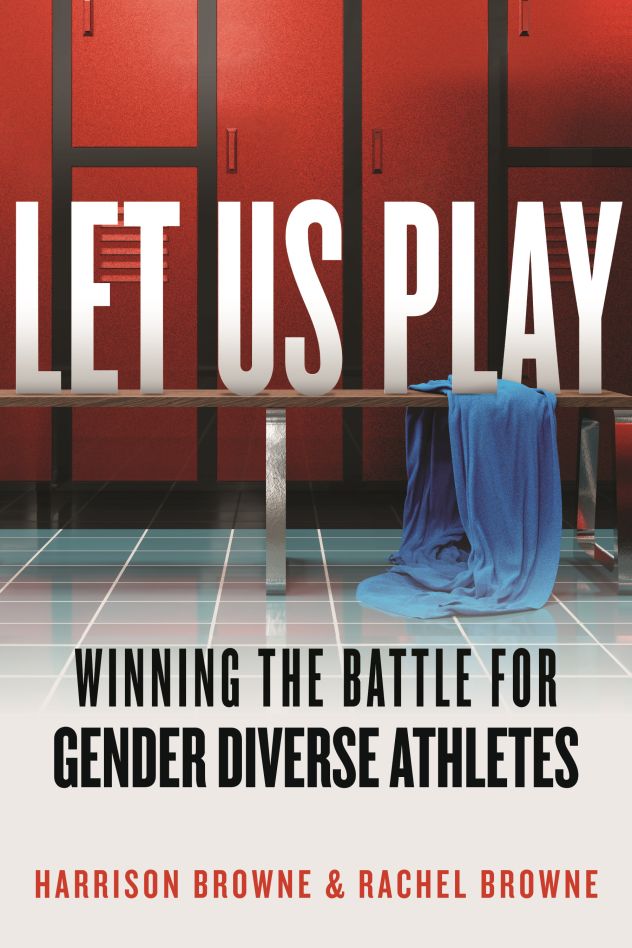
“Hockey was the one place where I could turn my brain off,” said Browne, who coauthored “Let Us Play: Winning the Battle for Gender Diverse Athletes.” (The paperback edition will be released on May 26.) “The one space where my body wasn’t the enemy. All that mattered was how fast my feet moved.”
“I could just say, ‘Hey, I’m the same Brownie — can you use he/him pronouns?’” he recalled. “And my teammates were like, ‘Yes, absolutely.’”
On the women’s hockey team at the University of Maine, that acceptance arrived years before Browne publicly came out. “I was living a double life,” he said. “I was Harrison in the locker room. But when I stepped out in public — my name on the roster wasn’t Harrison. I was announced with she/her pronouns. It became a bigger disconnect.”
The tension grew harder to ignore. Having experienced what it felt like to be seen — even in a limited space — he eventually found he could no longer go back into the closet every time he played.
“I had that taste of being myself in the locker room,” Browne said. “And I just knew: This is what I need.”
When Browne came out as a man publicly in 2016 while playing for the now-defunct professional women’s hockey team Buffalo Beauts, he became the first openly transgender athlete in professional team sports.
In the decade since, transgender athletes have become the focus of an escalating global debate over fairness, biology and the meaning of sports itself. The politics around athletics for kids, adults and professional leagues have shifted and then shifted again. But at the heart of all the intensity are a small number of athletes who just want to play the sports they love.

Transgender kids aren’t the problem in youth sports, one parent says
Researchers and athletes both say that the public conversation has outpaced — and frequently misrepresented — the science, leaving athletes such as Browne to carry the weight of a question far more complex than a hot take.
By the time Browne began writing “Let Us Play” with his sister, journalist Rachel Browne, the public debates about trans athletes were ramping up. “We were seeing this wave of anti-trans legislation really take off,” he said.
Such a ferocious reaction to a small group of people doing something perceived as negative has all the signs of a moral panic, Browne said. After the first wave of bathroom bills failed (since then, more have passed), politicians and others used this rhetoric to “get people whipped up over trans people — which distracts from broader issues that are more complicated to deal with — healthcare, poverty, human rights,” he said.
The question of hormones
The antipathy to trans people in sports has centered on a single idea: that hormones — particularly testosterone — determine athletic destiny.
From an athlete’s point of view, Browne sees that focus as both reductive and misleading. “When we focus so solely on one hormone,” he said, “we’re overlooking the real barriers to fairness in sport.”
Training, access to coaching, nutrition, socioeconomic status — these factors shape athletic outcomes far more consistently than any single biological variable, he argued.
“Sports have never been fair,” Browne said. “If they were, everyone would be the same height and have the same access to resources, but that’s just not reality.”
More than that, he worries that reducing athletes to physiology “dehumanizes people,” he said. “You’re just talking about their bodies — not their lives.”

Gender-affirming hormone therapy is linked to lower depression in transgender adults, study shows
A growing body of research shows, as Browne said, that the relationship between biology and performance is far more complex than one hormone creating a performance advantage or disadvantage.
“The single biggest misconception is that testosterone is some kind of permanent performance-enhancing drug, and once you’ve been exposed to it, the advantages are locked in forever,” Ada Cheung, an endocrinologist and trans health expert at Australia’s University of Melbourne, wrote in an email.
“People hear ‘male puberty’ and assume it creates an irreversible athletic superpower,” Cheung said. “But that’s not what the science shows.”
Gender-affirming hormone therapy, she explained, does reshape the body in measurable ways. In trans women, testosterone suppression and estrogen therapy lead to increases in fat mass and decreases in lean muscle.
In trans men like Browne, testosterone produces the opposite effect — increases in lean muscle and decreases in fat mass — though not to the same extent seen in cisgender men; they end up somewhere in-between. The effects on performance aren’t clear and vary by individual.
“The reality is far more nuanced than the ‘once male, always advantaged’ narrative that dominates public discussion,” Cheung said.
What research does say about trans athletes

A February meta-analysis published in the British Journal of Sports Medicine — spanning 52 studies and more than 6,400 participants — found that after one to three years of hormone therapy, trans women showed no significant differences from cisgender women in upper- or lower-body strength or aerobic fitness. While some differences in absolute lean mass remained, they did not translate into measurable performance advantages.
The latest research reflects the nuance that Cheung described.
Earlier work, including Cheung’s review in The Journal of Clinical Endocrinology & Metabolism, reached similar conclusions: Over time, key indicators of trans women’s performance shift toward those of cisgender women following hormone therapy.
Even at the molecular level, the body appears to respond dynamically to hormonal change. A 2025 study in Nature Medicine found that feminizing hormone therapy altered hundreds of circulating proteins in transgender women, reshaping their biological profile toward that of cisgender women across systems tied to metabolism, immunity and cardiovascular health. Similar findings have been shown in trans men.
This research repeatedly suggests that the physiological effects of hormone therapy are ongoing and affect a variety of the body’s systems. Over time, both trans men such as Browne and trans women who are athletes perform more like cisgender men and women.
Read more Asteroid mission captures rarely seen perspective of Mars during close flyby
That’s why it wasn’t a big surprise to researchers that a nonbinary and trans man team came in third in the men’s category at a recent Ironman competition in Oceanside, California.
Important questions remain. Much of the existing research is observational, with relatively small sample sizes, few longitudinal studies and only limited data on elite athletes or sport-specific outcomes.
“The direction of the evidence is consistent,” Cheung said. “But we do need better-designed studies, particularly in athletic populations.”
Importantly, Cheung wrote, body composition alone does not determine performance.
“People see that trans women may retain somewhat higher lean mass and jump straight to ‘unfair advantage,’” she said. “But absolute lean mass alone doesn’t dictate what your body can actually do.” Just like a bigger woman doesn’t necessarily outperform a smaller one.
Fat mass, endurance, hemoglobin levels, cardiovascular fitness, training, skill and access to resources all play roles in determining athletic performance and possible advantage or disadvantage, Cheung said. “The relationship between muscle and performance is much more complex than a simple more-muscle-equals-more-power equation,” she said.
Transgender athletes are underrepresented in elite sports — a fact that challenges the ideas of easy, widespread dominance. While more research is done and the issues are debated, nonbinary, intersex and trans athletes will continue to exist and play the sports they love.
Seeing yourself in your heroes

Representation matters: For younger athletes coming up behind him, Browne’s visibility offered something many had never seen before: a path.
Carly “CJ” Jackson, a nonbinary professional hockey player for the Seattle Torrent who appears in Browne’s film “Pink Light,” first encountered his story from afar. “Seeing him come out — it gave me space to accept myself for who I am,” Jackson said.
Years later, their lives would intersect in unexpected ways. Browne and Jackson had both played for the same teams — at the University of Maine and later professionally — just years apart, their careers running in parallel before finally meeting on set.
“I think about the impact Harrison had on my life,” Jackson said. “And I’m just one person. There are so many people he’ll never meet.”
For many transgender athletes, the debate over fairness is inseparable from a more basic question: Who gets to belong in sports at all?
“Sports are where people build friendships, learn teamwork, and become healthier,” said Alex Schmider, senior director of entertainment at GLAAD, an LGBTQ advocacy and media-monitoring organization, in an email. “Trans people play sports for the same reasons as everyone else — and denying those benefits is unnecessary and cruel.”
Schmider argues that the current wave of restrictions does more than limit participation.
“Politically motivated bans on trans athletes not only hurt them,” he said, “but also send inaccurate and harmful messages about who belongs.”

STREAMING NOW: The playing field: the battle over transgender athletes
Changing hearts and minds

In recent years, Browne has turned to storytelling — appearing in the breakout series “Heated Rivalry” and writing and producing his short film, “Pink Light” — as a way to reshape how transgender lives are understood. (“Heated Rivalry” streams in the United States on HBO Max, which is owned by CNN’s parent company, Warner Bros. Discovery.)
“Most people say they don’t know someone who is transgender in their personal life,” Schmider said. “So often their first introduction is through characters on television or in films.”
Stories such “Heated Rivalry,” he added, succeed in part because they depict athletes not as symbols but as teammates — bonded by a shared love of sport.
“When every player and fan can be themselves,” Schmider said, “everyone wins.”
Policy seems to be going in the opposite direction as that vision.
The International Olympic Committee’s 2021 framework moved toward a more evidence-based, sport-specific approach to transgender inclusion. But the most recent guidelines in March 2026 have instead installed a blanket testing regime — but only for women’s sports.
Over more than two decades in which trans women have been eligible to compete at the Olympic level, only one has participated: New Zealand weightlifter Laurel Hubbard, who did not finish her event.
“How is that grounds for a blanket ban?” Browne said. “There’s absolutely zero proof — and yet we’re seeing policies move in that direction.”
Rachel Browne, Harrison’s sister and coauthor of “Let Us Play,” said she worries about the secondary effects.
“So many sports try to align themselves with Olympic policy,” she said. “And that trickles down to amateur and youth levels — spaces where people should be freer to just play.”

If your kid just told you they’re trans, here’s what you should know
What are sports for?
Many athletes say that the thrill of the win isn’t as important to them as the camaraderie and relationships with their team members. Sports are a human experience and expression.
“It’s where you build friendships. It’s where you learn who you are,” Harrison Browne said. “Everybody deserves that escape.”
Maybe instead of being rigid and binary, athletics could be something more expansive, and more human, both Browne and Jackson mentioned when thinking about the future.
“Sports are art. They’re self-expression,” Jackson said. “And to deny that is to diminish what’s possible.”
Read more A ruse, a brave gamble or a fantasy? Why Trump’s most puzzling Iran move yet is unlikely to work