 By admin
Alabama has repeatedly come to the US Supreme Court to defend a racially discriminatory congressional map, asserting dubious claims and employing questionable tactics.
Read more Senate Republicans drop Trump ballroom funding from immigration bill
In 2023, the Supreme Court ruled against Alabama. Late Tuesday night, the emboldened conservative majority did the opposite, endorsing a state plan that eliminates a seat held by a Black Democrat that a special US district court has declared intentionally discriminatory.
The high court’s action demonstrated the truth that the nation’s protections for voting rights have not merely been “updated,” as Justice Samuel Alito insisted in late April.
They have been jettisoned.
The message in the , posted after 9 pm ET, is that states now have vast latitude to draw maps that dilute the voting power of Blacks, Latinos and other racial minorities. Even if all indications are otherwise, judges must assume legislators acted in good faith when they devised their voting maps.
Tuesday’s decision, hastily made without full briefing or oral arguments, culminates decades of retrenchment on voting rights by the contemporary court.
The majority reversed the three-judge lower court’s detailed, 78-page opinion from May 26 that reinforced earlier trial findings of Alabama’s racial discrimination in redistricting. The state has continued to defend a map with only one district among the state’s seven in which Blacks would have a fair chance to elect a candidate of choice.
Supreme Court turns toward an explosive final month with Trump’s priorities at stake
The state is about 27% Black. The special federal court had ordered a second Black district drawn. Over years of litigation, including in 2023 when the lower court panel’s determination was affirmed by the Supreme Court, the Alabama legislature went to lengths to dodge the mandate for a second Black district.
Yet, on Tuesday night, the Supreme Court majority faulted the US district court panel for failing to presume the state was acting with “legislative good faith.”
The lower court, in fact, said it had tried to give legislators the benefit of the doubt before finding Alabama had engaged in racially discriminatory vote dilution. Such dilution can occur when legislators draw maps concentrating Black voters in a single district, or alternatively dispersing them, to weaken their overall voting power.
“We reach this conclusion with great reluctance and dismay and even greater restraint — only after another exhaustive analysis of an extensive record, as the Supreme Court’s remand order and its precedent instructs us,” the panel wrote.
“The Legislature well knew that a plan without an additional Black-opportunity district would dilute Black Alabamians’ opportunity to participate in the political process, and it intentionally enacted that very plan,” the panel added.
On the panel was two judges appointed by President Donald Trump and one appointed by former President Bill Clinton.
The Supreme Court keeps overturning precedent. It swears that it’s not
Ruling in the middle of election season
Tuesday night’s Supreme Court decision was equally jarring in its assertion that the lower court was attempting to “alter the election rules on the eve of an election.”
It has been the Supreme Court’s own April 29 decision, eviscerating the 1965 Voting Rights Act in a separate Louisiana case, that has generated redistricting turmoil in several southern states as the midterm elections approach. Its new Tuesday night action is bound to add to the confusion.
In Alabama, as some primary voting had begun, the three-judge court said it was too late to abandon the remedial state congressional map with two Black districts that had been in place since 2024. (That map produced two Black members of Congress, both Democrats, in the 2024 cycle.)
Alabama legislators gambled the Supreme Court would ultimately side with them; they adopted legislation last month to hold a new set of primaries in August if the justices greenlit their preferred map, which indeed happened.
As a result, Alabama will likely have only one Democrat in Congress next year and six Republicans. It is notable that the Supreme Court’s 6-3 decision in Louisiana v. Callais on April 29 already appears to have benefitted Republicans in southern states.
While the Supreme Court has eroded guarantees for minority voters to exercise the franchise, the result continually has been to empower Republicans.
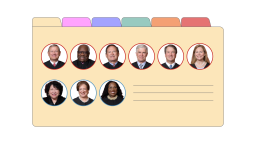
In their Tuesday, the three liberal justices recounted the Alabama’s many maneuvers and said the high court majority “rewarded Alabama’s defiance of court orders and blatant gamesmanship throughout this litigation.”
Justice Sonia Sotomayor, who wrote for the dissenters, said, “(T)he Court is squarely faced with a record of the turmoil it has caused and the harm it has wrought. Yet just as Alabama doubled down on racial discrimination, the Court today doubles down on chaos.”
Read more Trump suggests he won’t take down UFC ‘Claw’ on White House lawn
Sotomayor was joined by fellow Democratic appointees Elena Kagan and Ketanji Brown Jackson.
They also asserted the majority, “debases the democratic process by upending Alabama’s entire election in the name of permitting Alabama to discriminate against Black Alabamians.”
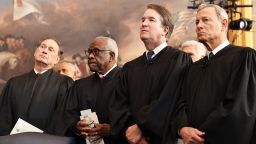
The six members of the court’s conservative majority, all Republican appointees, are Chief Justice John Roberts and Justices Clarence Thomas, Samuel Alito, Neil Gorsuch, Brett Kavanaugh, and Amy Coney Barrett. If one of them broke from the unsigned decision (only five are needed for a majority), it was not noted Tuesday night.
Impossible for challengers to meet Alito’s standards
After the 2020 census, Alabama’s state legislature produced a congressional plan that still had only one district (of the total seven) in which Black voters constituted a majority, despite the sizeable steady African American population.
The three-judge US district court first blocked use of the map in 2022, saying it likely violated the 1965 Voting Rights Act and observed that, “Alabama’s extensive history of repugnant racial and voting-related discrimination is undeniable and well documented.”
The high court allowed the state to use the disputed map in 2022 elections but then in 2023 narrowly affirmed the lower court’s decision requiring a second district that would allow Blacks to elect a candidate of their choice.
Takeaways from the primary elections in California, Iowa and elsewhere
Alabama continued to defy orders to draw a second district that would give Blacks close to a majority and the ability to be represented by a candidate of choice. The three-judge court held another trial in 2025, concluding that the revised plan violated the Voting Rights Act and the Fourteenth Amendment guarantee of equality.
The court imposed its own map intended to remedy the racial discrimination, which led Alabama to elect for the first time a second Black member of Congress.
In the current chapter of Supreme Court reinterpretation of voting rights law, the Supreme Court with its April decision in imposed tougher rules for assessing and remedying race discrimination in redistricting. Challengers could no longer point to the effects of vote dilution, Alito said in his opinion for the majority. Rather, they would have to show that state legislators likely had discriminatory purpose or, as Alito spelled out in his opinion, that “circumstances give rise to a strong inference that intentional discrimination occurred.”
The new criteria appeared to be nearly impossible for challengers to meet, even though Alito, the opinion’s author, minimized the changes and rejected dire predictions.
Tuesday night’s ruling in Allen v. Milligan all but proves their impossibility.
Alabama officials have argued that their single-Black-district map was drawn “for entirely nonracial reasons” to keep its Gulf Coast region intact in one congressional district.
The Supreme Court on Tuesday said the lower court panel, when it reexamined Alabama’s case in May based on Alito’s Louisiana v. Callais decision, wrongly “interpreted the State’s legal disagreement with the court’s earlier remedial order as proof of discriminatory animus.”
As the conservative high court majority grounded its new ruling in Callais and a succession of decisions favoring states over civil rights challengers, it also said the lower court had failed to sufficiently scrutinize the alternative map and arguments offered by those challenging Alabama.
“While federal courts should not impose changes close to an election,” the unsigned decision concluded, “States are free to decide for themselves whether last-minute changes to an election are in their best interests.”
Such sentiment, the liberal dissenters declared, will produce havoc in the upcoming weeks. They noted that Alabama officials will have to change the voter registrations of hundreds of thousands of voters.
Alabama’s history of discrimination against its Black citizens is well documented and legendary. Congress passed the 1965 Voting Rights Act only after the “Bloody Sunday” attack on the Edmund Pettus Bridge in Selma. During that March 7, 1965, clash, sheriff’s deputies whipped and beat civil rights marchers as they tried to cross the bridge.
Tracking the major Supreme Court cases of 2026
The lower court in the current case said it deliberately turned away from that history to focus on the current circumstances and defer to legislators.
Observed Sotomayor, “The reason the District Court found intentional discrimination even after affording such deference to the Alabama Legislature is simple: The record is crystal clear.”
If that three-judge panel erred in its findings against state lawmakers, she added, “then there is no realistic case in which the presumption of legislative good faith can ever be rebutted.”
Read more Trump suggests he hasn’t dropped the ‘anti-weaponization’ fund