 By admin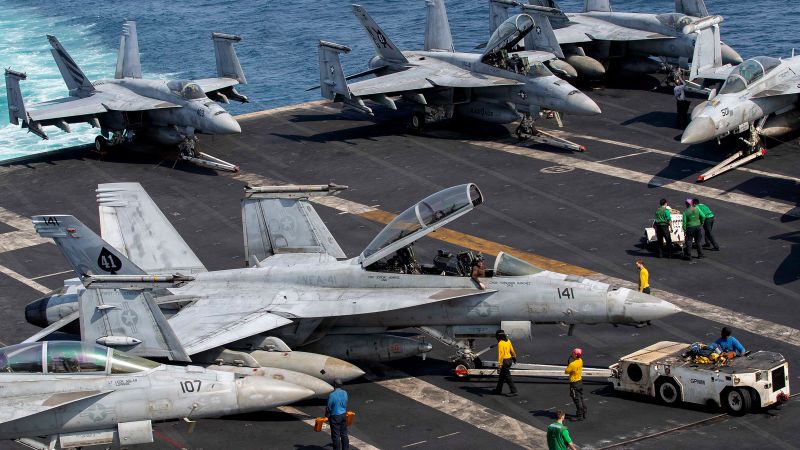
The USS Abraham Lincoln is in the midst of a record-setting deployment, kept out of port for more than six months as the carrier’s crew faces morale and mental health concerns. The ship may break a record for the longest trip away from its home port for a US carrier since the Vietnam War.
Read more Time slipping between your fingers? Try this simple hack to make the clock work for you
That record was set just months ago by the USS Gerald R. Ford after that ship completed a 326-day deployment that included operations against Iran and Venezuela.
It’s part of a pattern, with the US Navy increasingly asking its aircraft carrier groups to exceed the service’s recommended deployment duration of seven months, according to a CNN analysis of deployment announcements and the USNI News fleet tracker.
Experts and former officials have warned that the trend could place more stress on the ships and lead to burnout among sailors or even push some to leave the Navy altogether.
A crew member serving on the Lincoln described morale on the ship as very low and said they had heard repeatedly about suicidal ideation by fellow crew members. And there were regular strains on essential amenities — toilets and water fountains around the ship frequently closed and hot water often unavailable, the crew member said.
“Everyday we wake up and listen to our Captain speak, we are desperately hoping and anxious for updates on our return,” the crew member told CNN.
Other sailors aboard the Lincoln who spoke with CNN described conditions unlike their prior deployments, largely due to the combat that has kept the carrier from making stops at friendly ports. Ships can take on new supplies and allow its sailors to rest and relax during those port calls.
The ship has experienced intermittent food shortages, low supplies of hygiene items, and problems with the water system, sailors and family members told CNN.
“You used to be able to go to the ship store and get as many items as you want, with every hygiene product consistently available,” one sailor, who requested anonymity due to fear of reprisal, told CNN. Now there are limits on purchases and “hardly any hygiene products (are) readily available.”
Kate Kuzminski, a defense expert who oversees research at the Center for a New American Security think tank, said the Navy needs to realign its deployment model with reality to properly set expectations for sailors and their families.
“What does it do to a family who’s newly assigned to the Ford?” asked Kuzminski, who argued that “it could drive people’s or families’ decisions to get out (of the Navy).”
CNN previously reported that two sailors assigned to the Lincoln strike group have jumped overboard in recent months. Both were rescued alive, US officials said. Others were prevented from jumping, according to reports from the Navy Times and Stars and Stripes.
The father of a sailor aboard the Lincoln who spoke to CNN on the condition of anonymity, said he understands sailors like his child join the Navy to do their jobs and doing them in combat is inherently hard – but he questions why relief hasn’t come sooner and whether some of the mental strain from the long deployment could have been prevented.
The Navy said in a statement to CNN, “We have not observed an increase in suicidal ideations or attempts aboard the ship. We take every service member’s well-being seriously and have religious, medical and mental health professionals available to assess and address concerns as they arise.”
A US official added that the Navy does not believe there is a correlation between deployment length and thoughts of self-harm and that man overboard incidents are not unique to this fleet.
President Donald Trump on Friday appeared to address a question about the length of the Lincoln deployment, telling reporters that it had been “not nearly long enough.”
The wife of one service member aboard the Lincoln who requested anonymity told CNN’s Jake Tapper on Friday that the president doesn’t think “before he talks,” and urged both he and Secretary of Defense Pete Hegseth to have “some empathy.”
“Take some accountability for what’s going on with your military, your ships, in your war. In your war. It’s infuriating,” she said.
Increasing stress on the fleet
The median length of US-based aircraft carrier deployments has steadily increased since 2020, according to the data reviewed by CNN.
The Navy’s plan has aimed to provide predictable three-year cycles for sailors that include a seven-month/210-day deployment, according to Adm. Daryl Caudle. Between 2018 and 2022, most deployments remained under or within a few days of the target length.
However, the sea service has routinely missed that mark since the October 2023 Hamas terror attacks against Israel sparked a spate of extended deployments.
The USS Gerald R. Ford and the USS Dwight D. Eisenhower both saw deployments extended after the Israel-Hamas war began — the Ford returned home in January 2024 after 260 days away, and the Ike’s July 2024 homecoming came after 274 days.
Three different carrier deployments that began in 2024 exceeded 250 days.
The following year, 2025, saw the carrier force even more stretched, with two extended deployments passing 270 days, including the Ford’s post-Vietnam War record breaker 326-day trip, which began in June 2025.
That deployment took the supercarrier from homeport in Norfolk, Virginia, first to Europe and next to the Caribbean, where its planes struck Venezuela during the raid that captured former strongman Nicolas Maduro, and then to the Middle East where it participated in Operation Epic Fury against Iran despite a major fire.
Experts told CNN that on extended missions, like that undertaken by the Ford and the Lincoln, components wear out and repairs at sea serve as temporary band aids. Other minor issues also begin to compound: arresting cables that catch landing aircraft begin to fray, and saltwater seeps into shipboard systems, among others.
Those issues can add up and increase the chances of mishaps, the sources said.
Burnout for crew members and their families can also become a concern, experts and former officials told CNN.
Retired Rear Adm. Bruce Gillingham, who previously served as the Navy Surgeon General during the Covid-19 pandemic, told CNN that one of the “critical factors” of extended deployments during the pandemic, which did not allow ships to make port calls, was “how resilient the sailors and Marines were.”
Read more Murder is at lowest rate since the 1950s. Trump touts it as a personal success.
“This is not unprecedented,” Gillingham said. “I mean, when you look at the history of the Navy, world events require that deployments be lengthened, and the sailors answer the call … The Navy plays the away game, that’s the nature of the business, and it’s very good at it. It doesn’t mean that it doesn’t put stress on the people and the ships.”
Retention of naval aviators and maintenance personnel has been an area of significant concern this year, according to sources familiar with the Navy’s internal discussions.
Earlier this year, Hegseth ordered a review of retention struggles for sailors assigned to Navy Strike Fighter Squadrons, according to a March memo from Hegseth obtained by CNN. To retain top talent, the Navy is also offering flight officers and naval aviators tens of thousands of dollars annually in bonuses.
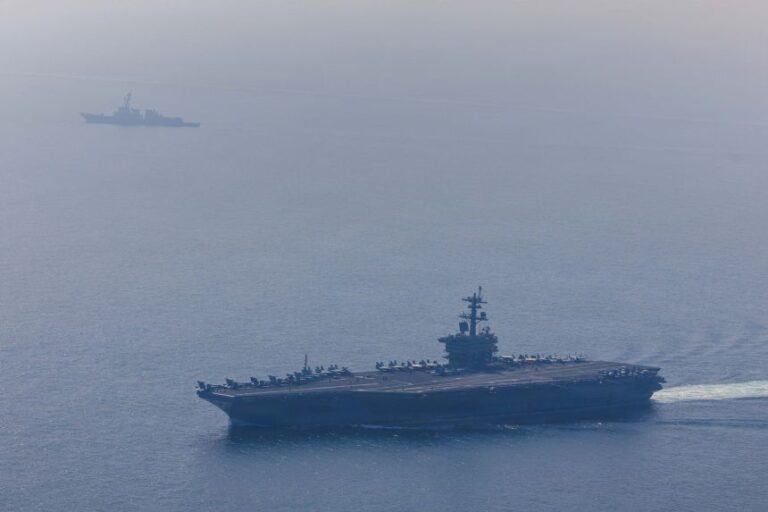
Meanwhile, a third 2025 deployment — that of the USS Abraham Lincoln — remains underway nearly nine months after the ship left San Diego on November 21. Most of its crew last touched land in Guam for a December 11 port call. Although a Japan-based carrier, the USS George Washington, is on its way to relieve the Lincoln from its blockade duties in the Persian Gulf, the Lincoln may break the Ford’s deployment length record on its way home to California.
Struggles on the Lincoln
The continued deployment of the Lincoln has placed strains on families, several relatives of those serving on the carrier told CNN.
Care packages sent by sailors’ family members sometimes arrive months late or go missing entirely, Ashley T., the mother of a sailor aboard the Lincoln said. She requested that CNN withhold her last name to protect the sailor’s identity.
“I understand they are in a combat zone, but if they aren’t allowed any port calls, the least (the Navy) could do is make sure they are getting packages in a timely fashion,” she said.
Another family member, who requested anonymity to protect their sailor, shared photos of overflowing toilets in sewage-saturated restroom areas — an issue also experienced by the Ford during its deployment.
The spouse of a service member aboard the Lincoln who spoke to CNN told Tapper on Friday, “He is saying that it is the worst deployment that he’s ever been on.”
“My husband is a very leave-it-at-work type of person,” she said. “He gets his job done. He comes home, and he lets it go at work. He does his best. He works very hard for United States military, and he’s even said that he finds himself changing. He feels himself being angrier and more frustrated, and that’s just very unlike him. So it’s very hard to hear that as his wife when I can’t do anything about it. I can’t help him.”
The conditions have fueled concerns about sailor mental health as well and scrutiny from lawmakers such as Democratic Sen. Richard Blumenthal of Connecticut, who wrote a letter to the Pentagon demanding answers on that status of the crew.
Leaders aboard the strike group’s ships are working to improve conditions for their sailors, they previously told CNN.
Capt. Casey Mahon, who commands the USS Frank E. Petersen, Jr., acknowledged to CNN’s Pamela Brown aboard the destroyer last month that the combat conditions pose a “very stressful situation” for the sailors. He said the ship holds group therapy and venting sessions where sailors can provide feedback, and leaders encourage lighter-hearted methods of stress relief such as ice cream socials and bulletin boards where sailors can post memes about their experiences.
And despite the challenges, the sailors of the Lincoln strike group have launched approximately 10,000 aircraft flights supporting strikes on Iran and enforcing the US blockade of the country, according to US Central Command.
Yet Navy officials have been questioning the current model in light of recent operations.
The Navy’s top enlisted sailor, Master Chief Petty Officer of the Navy John Perryman, recently criticized the existing cycle as a “conveyor belt that’s very prescriptive” derived from a “peacetime mindset.”
“We’re going to have to come up with a different force generation model,” Perryman said while discussing the USS Gerald R. Ford’s 11-month deployment during a recent Military Officers Association of America event.
Part of the problem is that aircraft carriers are a finite asset: the US has eleven of the ships, some of which are aging and pending replacement with new Ford-class supercarriers. Not all the ships are simultaneously available due to maintenance requirements and reactor fueling schedules as well.
The new Ford-class carriers have faced repeated delays, too. The USS John F. Kennedy, which began its final sea trials this week, is scheduled for delivery to the Navy in March 2027 — nearly two years later than originally projected.
And recently announced changes to the USS Doris Miller — the next scheduled Ford-class supercarrier — could delay its construction even further, experts told CNN.
Trump directed that the Navy scrap its plans to use an electromagnetic system for launching aircraft from future Ford-class ships. The current ships in the class use the system, but the Miller and future ships will use steam-powered launch catapults like those on the legacy Nimitz-class aircraft carriers.
That will require the Miller to be redesigned, Hudson Institute shipbuilding expert Bryan Clark told CNN. The cost “will probably be into the billions” and it could delay the carrier — which was expected to be in service around 2034 — “until the end of the next decade.”
Any delay could force the Navy to extend deployments to cover for a ship it had planned to have available or operate its last-generation Nimitz-class carriers beyond their 50-year service life.
Davis Winkie’s work at CNN is supported by a partnership between Outrider Foundation and Journalism Funding Partners (JFP). CNN retains full editorial control of the reporting.
CNN’s Kaanita Iyer, Sean Lyngaas, Zachary Cohen, Brian Todd and Ross Adkin contributed to this report.