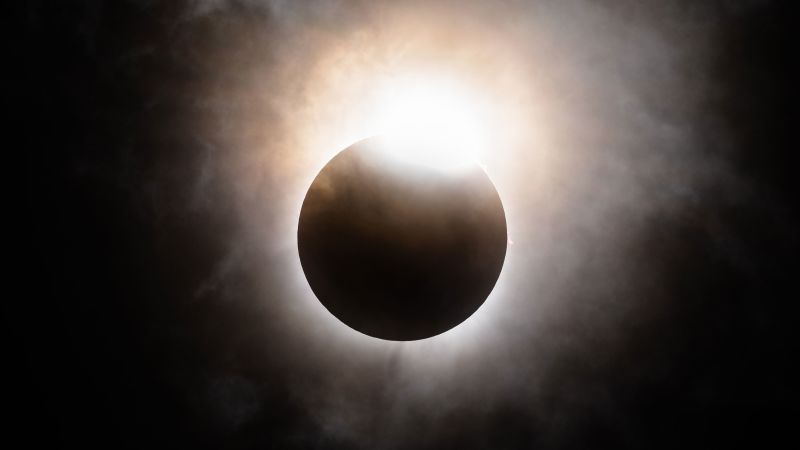
An eerie phenomenon occurs around eclipse totality. Scientists are trying to unravel the mystery

Racing water. Phantom serpents. Rippling patterns of light and dark.

Solar eclipse watchers have for centuries vividly described an eerie phenomenon known as shadow bands that appears just before and after totality — the period when the moon completely blocks the sun’s light and the sky goes dark. Long dark lines, separated by white spaces, race across the ground or sides of buildings.

Read more Blanche set to lead a Justice Department shaped to serve Trump

David Turnshek, a professor of physics and astronomy at the University of Pittsburgh, first witnessed shadow bands as a teenager.

“I guess I would have been 14 years old. I went to see a total eclipse near Virginia Beach. It was 1970, and I had made my own telescope, and I went down there to try to photograph the eclipse,” said Turnshek, who is also the director of the Allegheny Observatory in Pittsburgh.

“And while I was down there, I noticed right before the total eclipse, these bands of light were sweeping across the ground.”

The human eye can easily detect shadow bands, but they are difficult to photograph and capture on video because of the subtle contrast.

Turnshek’s research as an astronomer has primarily focused on galaxy formation and quasars, the luminous cores of distant, ancient galaxies. However, he has retained his youthful curiosity about shadow bands — a phenomenon with two competing theories but no definitive explanation.

An upcoming total solar eclipse on Wednesday will provide scientists with another opportunity to study this mystery. Sky-gazers can watch for the spectacle when the path of totality sweeps through the northern tip of Russia, eastern Greenland, western Iceland, the northern half of Spain and northeast corner of Portugal.

🚀 Get Countdown newsletter

  • Sign up for updates from CNN Science on the upcoming total solar eclipse and whenever there’s a must-see, out-of-this-world expedition. Plus, take deep dives into the future of space exploration.

Surprising results

In 2017, a total solar eclipse crossed the United States from coast to coast for the first time in 99 years. After securing NASA funding to study the occurrence, Turnshek traveled to Tennessee with a group of University of Pittsburgh undergraduates who called themselves the Pitt shadow bandits.

Their goal was to test the leading theory, first put forward in the 1980s, that turbulence — the irregular motion of air currents in the atmosphere — caused shadow bands. When the moon obscures most of the sun just before totality, leaving only a thin sliver of sunlight, the turbulence becomes visible. It’s the same reason why stars, when viewed from Earth, appear to twinkle. However, in the case of the sun, the effect isn’t usually visible because of its massive size.

The group placed light detectors called photodiodes on the ground and on board a high-altitude balloon, which collected data on the light patterns before and after totality.
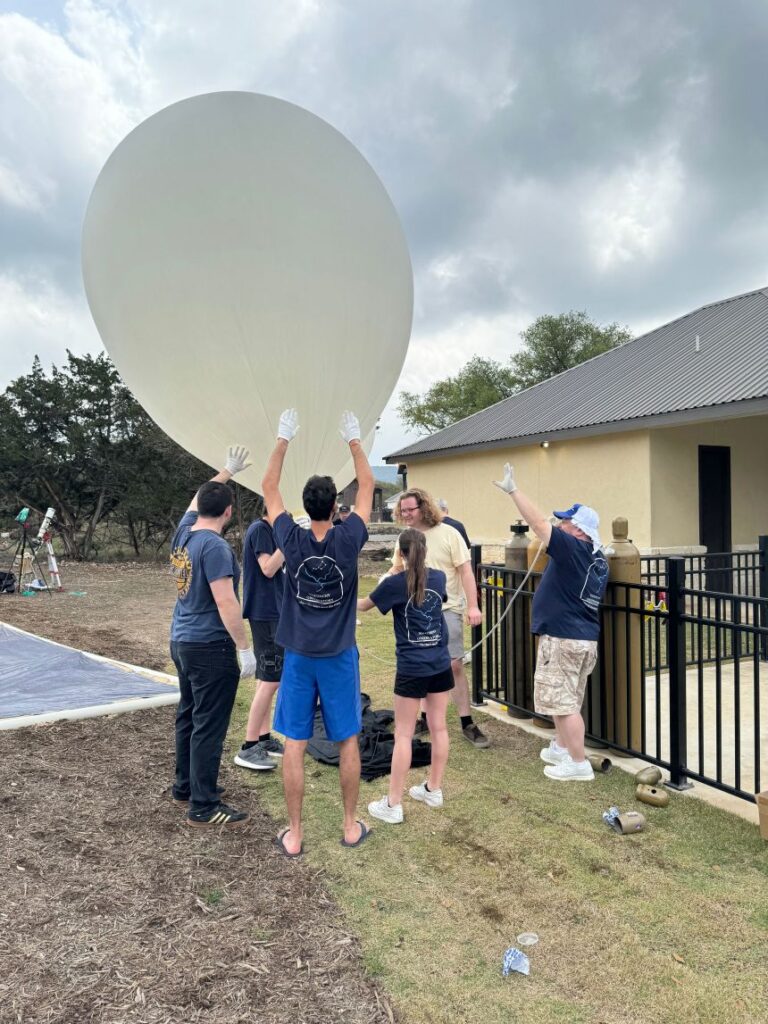
The University of Pittsburgh research team prepares a high-altitude balloon.
courtesy The University of Pittsburgh, Allegheny Observatory and Department of Physics & Astronomy

This data was then analyzed using spectrograms, a way of visually representing the strength of light waves and how they change over time. If the prevailing theory was correct, the team would observe shadow bands on the ground, but not on the balloon, which was 25 kilometers (15.5 miles) high — above most of Earth’s atmosphere.

The results were surprising, Turnshek recalled. The researchers found a sustained signal of 4.5 hertz — a measure of how often a light wave passes a fixed point per second, at both high altitude and on the ground.

“We saw this effect above the atmosphere and on the ground, which meant that the leading theory for shadow bands could be wrong in the sense that that wasn’t the only explanation for shadow bands,” he said.
Related article
c-GettyImages-2147619303.jpg
Spencer Platt/Getty Images

How to watch August’s total solar eclipse safely while protecting your vision

6 min read

The findings from the 2017 eclipse suggested another explanation, known as the diffraction-interference, might be responsible for shadow bands. Diffraction is what happens to light waves when they encounter an obstacle. For example, when light bends around a sharp obstacle or boundary, such as a knife edge, the waves bend and interfere with one another to create bands of dark and bright light.

“At one point in time it was the most popular theory, that it was some kind of diffraction-interference effect,” he said.

“The thought is, ‘Well, we have an eclipse, and the moon, even though it has a curved edge, acts as some kind of a knife edge.”
Related article
From left: the scene of the total eclipse at 3:03 pm, 3:04pm, and 306pm.
Kimberly Rosvall/Indiana University

Why birds sang after a total solar eclipse, according to new research

6 min read

The team checked to make sure that the signal was not the result of faulty electronics that produced false readings. Turnshek and his student researchers looked for an opportunity to try and replicate the results, noting it didn’t necessarily mean that the prevailing theory was incorrect.

“When you have a complicated situation in science, it’s often the case that two things are true at the same time, contributing to the phenomena,” Turnshek said.

Nearly a decade later, during the April 8, 2024, total solar eclipse, Turnshek took another student research team to Concan, Texas, within the path of totality — and where the weather was expected to be clearest.

Read more Testing is underway on vaccines to intercept brewing colon cancer before it takes root
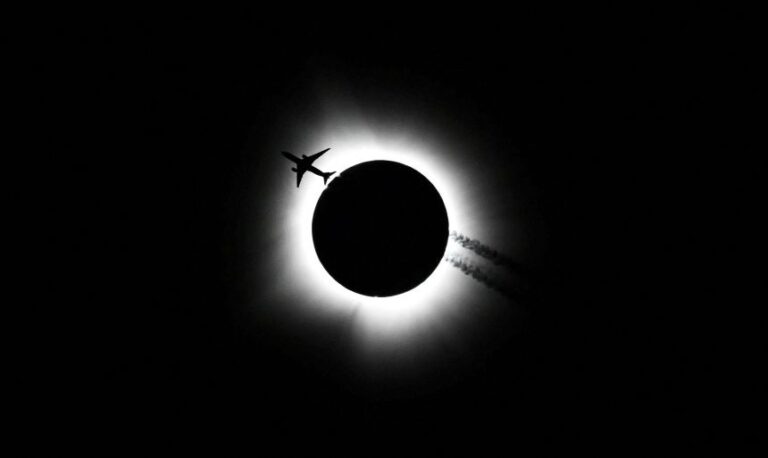
An airplane passes by as the total solar eclipse is seen from Bloomington, Indiana, on Monday, April 8.
The solar eclipse, in pictures
33 photos
An airplane passes by as the total solar eclipse is seen from Bloomington, Indiana, on Monday, April 8.
Bobby Goddin/USA Today Network/Reuters
The solar eclipse, in pictures
An airplane passes by as the total solar eclipse is seen from Bloomington, Indiana, on Monday, April 8.
Bobby Goddin/USA Today Network/Reuters
People gather on the National Mall in Washington, DC, to view the eclipse.
Kent Nishimura/Getty Images
A visitor poses for a photograph with oversized eclipse glasses during a watch party at Niagara Falls in Ontario.
Al Drago/Bloomberg/Getty Images
A newly married couple views the eclipse after a <a href=
mass wedding in Russellville, Arkansas. They were one of 358 couples who tied the knot at an “Elope at the Eclipse” event.” class=”wp-image-8961″ width=”1024″ height=”713″ />
A newly married couple views the eclipse after a mass wedding in Russellville, Arkansas. They were one of 358 couples who tied the knot at an “Elope at the Eclipse” event.
Mario Tama/Getty Images
The moon covers the sun during the eclipse in Magog, Quebec.
Stan Honda/AFP/Getty Images
Visitors watch the eclipse move into totality at a watch party in Bloomington.
Chet Strange/Bloomberg/Getty Images
The Baily's Beads effect and red prominences coming off the sun are pictured during the eclipse as seen from Magog.
The Baily’s Beads effect and red prominences coming off the sun are pictured during the eclipse as seen from Magog.
Stan Honda/AFP/Getty Images
Eclipse watchers hold their hands up to the sky, hoping the clouds will part in Dunkirk, New York.
Elizabeth Frantz/Reuters
A White House staffer looks up at the eclipse as US President Joe Biden arrives at the Dane County Regional Airport in Madison, Wisconsin.
Andrew Caballero-Reynolds/AFP/Getty Images
People observe the eclipse in Torreón, Mexico.
Daniel Becerril/Reuters
Melissa and Michael Richards use solar goggles to watch the eclipse in Wooster, Ohio.
Erin Hooley/AP
The eclipse is seen from the Amistad National Recreational Area in Del Rio, Texas. It is one of the few National Park Service sites that was directly in the eclipse's path of totality.
The eclipse is seen from the Amistad National Recreational Area in Del Rio, Texas. It is one of the few National Park Service sites that was directly in the eclipse’s path of totality.
Sarah Silbiger for CNN
Laquishia Ferguson and her boyfriend, Easy Ash, watch the eclipse from Jacksonville Beach in Florida.
Laquishia Ferguson and her boyfriend, Easy Ash, watch the eclipse from Jacksonville Beach in Florida. “I’m wowed,” Ferguson said.
Corey Perrine/Florida Times-Union/USA Today Network
People watch the eclipse in Wapakoneta, Ohio.
Matthew Hatcher/Getty Images
People watch the eclipse from the Edge observation deck at Hudson Yards in New York City.
Eduardo Munoz/Reuters
Nataya Tindle watches the eclipse outside of Union Station in Washington, DC.
Rebecca Wright/CNN
Frederik De Vries, one of the eclipse watchers on the National Mall in Washington, DC, looks up at the sun using binoculars outfitted with solar film.
Kent Nishimura/Getty Images
The moon begins to cover the sun in Eagle Pass, Texas.
Eric Gay/AP
Barbara McLaughlin and her granddaughter test out their eclipse glasses as they wait on the National Mall in Washington, DC.
Kent Nishimura/Getty Images
A National Park volunteer looks through a telescope at the eclipse watch party at the Amistad National Recreational Area in Del Rio.
Sarah Silbiger for CNN
People watch the eclipse from the Augusta National Golf Club in Georgia, where practice rounds were being held ahead of the Masters tournament.
Mike Blake/Reuters
An airplane passes overhead as a partial eclipse is seen in the New York City borough of Queens.
Andrew Kelly/Reuters
Passengers sit on a special <a href=
path-of-totality flight offered by Delta Air Lines on Monday.” class=”wp-image-8980″ width=”1024″ height=”682″ />
Passengers sit on a special path-of-totality flight offered by Delta Air Lines on Monday.
Leonardo Benassatto/Reuters
People sit next to the Horseshoe Falls in Niagara Falls as they wait for the eclipse.
Geoff Robins/AFP/Getty Images
A child fills in a Junior Ranger activity book during an eclipse watch party at the Amistad National Recreational Area in Del Rio.
Sarah Silbiger for CNN
People watch the eclipse begin in Eagle Pass.
Eric Gay/AP
A visitor poses with eclipse glasses during an eclipse viewing event at Niagara Falls.
Al Drago/Bloomberg/Getty Images
People gather on the Edge observation deck at Hudson Yards in New York City ahead of the eclipse.
Charly Triballeau/AFP/Getty Images
People in Niagara Falls gather on a sightseeing boat to break the Guinness World Record for the largest group of people dressed as the sun (309).
Jenna Zucker/Reuters
Kylee and Michael Rice prepare to take a hot air balloon ride before the <a href=
mass wedding event in Russellville.” class=”wp-image-8987″ width=”1024″ height=”684″ />
Kylee and Michael Rice prepare to take a hot air balloon ride before the mass wedding event in Russellville.
Mario Tama/Getty Images
Artists sell eclipse-themed items at a popup art market in Del Rio on Saturday.
Sarah Silbiger for CNN
Gwen Rychlik gets a moon and cowboy hat tattoo during the Solar Eclipse Fest in Del Rio on Saturday.
Sarah Silbiger for CNN
A sculpture advertises Del Rio's Solar Eclipse Fest on Saturday.
A sculpture advertises Del Rio’s Solar Eclipse Fest on Saturday.
Sarah Silbiger for CNN
The solar eclipse, in pictures

Despite the researchers deploying more sensitive sensors and extending the scope of measurements, cloud cover meant that they did not detect shadow bands. The team deployed two high-altitude balloons with light sensors and 31 weather balloons to measure temperature, pressure, wind speed and humidity.

“For the most part, it was cloudy on the ground, but we launched the two high-altitude balloons, and we didn’t see any signal whatsoever due to shadow bands despite the fact that our detector was much more sensitive,” Turnshek said. “Of course, I was incredibly disappointed.”

Related article
Ring-tailed lemurs look on as children view a solar eclipse at the Japan Monkey Center in Inuyama city in Aichi prefecture, central Japan on May 21, 2012. Millions turned their eyes to the sky on both sides of the Pacific to gaze excitedly as a solar eclipse created a
Ring-tailed lemurs look on as children view a solar eclipse at the Japan Monkey Center in Inuyama city in Aichi prefecture, central Japan on May 21, 2012. Millions turned their eyes to the sky on both sides of the Pacific to gaze excitedly as a solar eclipse created a “ring of fire” at dawn in Asia and crept towards a darkening western US. AFP PHOTO / JIJI PRESS JAPAN OUT (Photo by JIJI PRESS / JIJI PRESS / AFP) (Photo by JIJI PRESS/JIJI PRESS/AFP via Getty Images)
Jiji Press/AFP/Getty Images

Some perplexing animal mysteries stumped scientists during the 2017 eclipse. Here’s why

8 min read

The team was also able to deploy an additional set of light sensors on an aircraft that flew in Vermont, where the skies were clearer. The spectrogram from the aircraft, however, did not show a 4.5 hertz signal — the pattern they found on the high-altitude balloon during the 2017 eclipse. The researchers also weren’t able to make any corresponding ground-based shadow band observations in Vermont, making the data inconclusive.

An open book

Turnshek will travel to León, Spain, with some colleagues to see the upcoming solar eclipse, but he said he will be unable to replicate the same experiment because of the logistical complexity involved. This time, he’s primarily there as a tourist.

“I decided initially I would just go to Spain and enjoy looking at the eclipse because it’s an incredible thing, but of course, I couldn’t help myself, and I’m taking one of our electronic detectors to Spain.”
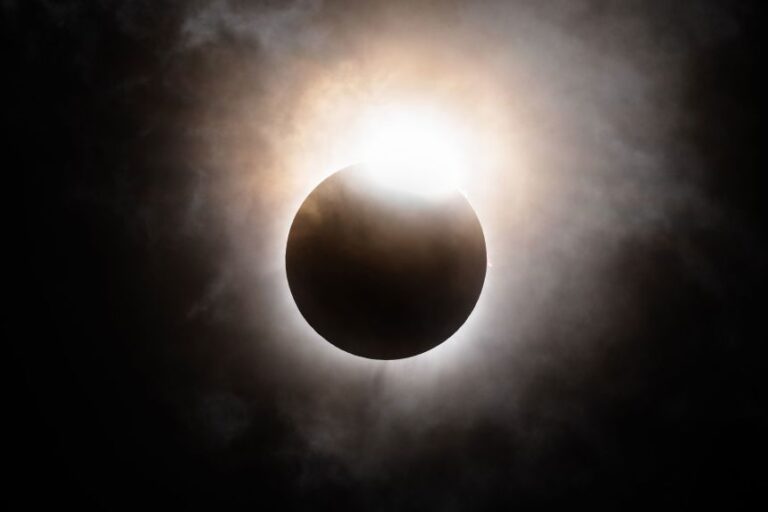
The moon begins its descent below the sun's horizon during a total solar eclipse in April 2024 in Brady, Texas.
The moon begins its descent below the sun’s horizon during a total solar eclipse in April 2024 in Brady, Texas.
Brandon Bell/Getty Images/FILE

At best, Turnshek said he hopes to detect and capture video of the shadow bands, using the same ground-based equipment he deployed in Texas in 2024. But without measurements from above, using a plane or balloon, it won’t be possible to resolve the ambiguous results.

“Maybe somebody will have read our 2017 and 2024 results, and will say, ‘I’m in Spain. I’ve got a plane.’”

How to see the shadow bands

Turnshek is not the only researcher looking to record shadow bands on Wednesday.

Gordon Telepun, an eclipse chaser who worked as a NASA ambassador to share knowledge about eclipses in 2017 and 2024, will be on the Spanish island of Mallorca for the eclipse. He has seen shadow bands at five of the seven eclipses he has witnessed.

“You’re not going to see them on grass or asphalt or something like that. You need a smooth, light-colored background,” said Telepun, who has a created an eclipse app that includes a reminder of when to look for the bands.

“If you’re going to see them, you have to know to look for rows. Know in your mind what you’re looking for. They’re going to be very faint.”
Related article
eclipse-glasses-joe-cnnu.jpg
parsely

The phenomenon of a solar eclipse is a sight to see. Watch it safely with these glasses (Courtesy CNN Underscored)

Shadow bands are easy to miss, he noted, because they happen just before totality — the most exciting time when viewers are wearing solar glasses and looking up at the final, thin crescent of the sun.

Joe Conti, an independent researcher and physics enthusiast based in Massachusetts, is inviting eclipse observers across Iceland and Spain to capture the optical mystery on their smartphones as part of a citizen science project. Five groups have expressed interest in participating so far, he said.
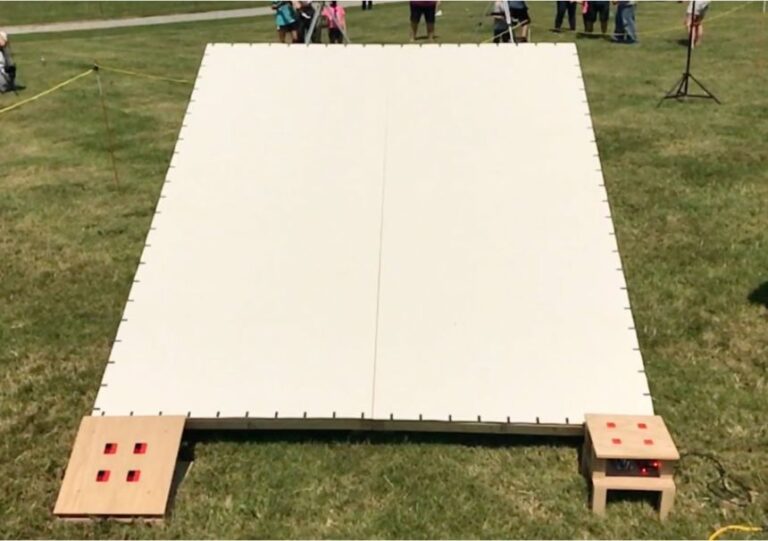
The University of Pittsburgh researchers use a screen and sensor setup to capture shadow band phenomena during a total solar eclipse.
courtesy The University of Pittsburgh, Allegheny Observatory and Department of Physics & Astronomy

Conti recommends setting up a simple observation board made from cardboard and covering it with a white sheet. He said he hoped the data collected can perhaps help the broader scientific community close the book on what causes shadow bands.

For those lucky enough to be in the path of totality on Wednesday and wanting to catch a glimpse of shadow bands, Turnshek’s advice is to be south of mountains and coast, where cloud cover is more likely to gather.

He also recommends heading west to make sure the sun is as high as possible in the sky. The upcoming eclipse takes place in the evening local time when the sun will be setting.

“Even in clear weather,” he said, “it’s cloudier near the horizon.”

Sign up for updates from CNN Science on the upcoming total solar eclipse and whenever there’s a must-see, out-of-this-world expedition. Plus, take deep dives into the future of space exploration.

Read more Trump’s Patriot Games are billed as a youth sports contest. They’re also a test of patriotic branding

By admin

Leave a Reply

Your email address will not be published. Required fields are marked *