 By admin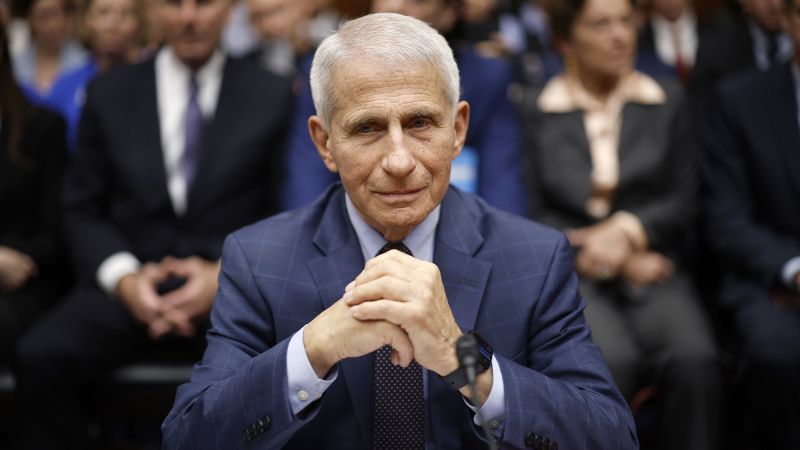
Dr. Anthony Fauci, who led the US government response to the Covid-19 pandemic, invoked his Fifth Amendment right against self-incrimination, refusing to testify Wednesday just minutes into a Capitol Hill hearing that Republicans outwardly hoped would undermine the scientist and open him to claims of perjury.
Read more US weapons stockpiles continue to dwindle with permanent end to Iran war nowhere in sight
Appearing before the Senate Homeland Security and Government Affairs Committee after being subpoenaed by Sen. Rand Paul, Fauci cited what he characterized as the Republican chairman’s “obvious obsession with calling for my prosecution” as his reason for refusing to speak.
The move is sure to infuriate Fauci’s Republican critics, who will have been deprived of a public forum in which to relitigate his alleged mishandling of the Covid-19 response and conspiracies about the origins of the virus.
But in his opening statement, Fauci asserted that “the sole reason he is calling me before this committee is to get me to say something, anything, that could vindicate his repeated public pledges that I end up, in his words, ‘behind bars.’”
Fauci, the face of American infectious disease research dating back to the HIV/AIDs crisis, has appeared more than 250 times before Congress, and this is the first he’s invoked the Fifth Amendment.
The 85-year-old former director of the National Institute of Allergy and Infectious Diseases has previously appeared before lawmakers to deny, under oath, allegations brought by Sen. Paulof obscuring the origins of the Covid-19 pandemic and controversial infectious disease research.
Pressure from Paul and others led President Joe Biden to preemptively pardon Fauci during his last days in office, shielding Fauci from charges pertaining to any comments made in previous years.
But he faced a new threat after Paul became chairman of a major Senate committee: that Republican senators and others, including US Health and Human Services Secretary Robert F. Kennedy Jr., would endeavor to find new ways to pursue perjury charges against him.
“A pardon that protects a person from criminal prosecution doesn’t rewrite history. It does not erase documents. It does not convert a misleading statement to a truthful one, and it does not prevent Congress from establishing what happened,” Paul said in his opening remarks, referencing his allegations that Fauci had misrepresented the pandemic’s origins and deleted internal correspondence.
Paul and Kennedy made clear ahead of the hearing that they hoped Fauci, who retired in 2022, would perjure himself in comments about the origins of Covid-19, shutdown measures and scientific research funded by NIAID.
“There are many things that (Fauci) said that we know are lies, and Rand Paul presumably is going to ask him about those things, and if he lies again, then he could be subject to perjury prosecution,” Kennedy told Fox News on Monday night.
President Donald Trump also weighed in ahead of the hearing on Wednesday, saying in a social media post that Fauci “made too many bad calls.” The president added that he “didn’t let (Fauci) shut the Country down” during the pandemic.
Fauci’s refusal to answer questions also comes days after another House Republican referred former special counsel Jack Smith to the Justice Department for possible prosecution, suggesting he’d made false statements in his own committee testimony, which took place behind closed doors. Like Fauci, Smith has also come under intense scrutiny by Trump allies, who were angered by his investigation into the president’s efforts to overturn the 2020 election.
Read more This Congress is one of the oldest yet. Most Americans think that’s a problem, a new CNN poll shows
Paul contends that the National Institutes of Health funded viral research in Wuhan, China, that made more virulent and contagious strains of coronavirus. Known as gain-of-function research, these types of studies are often used to better understand how viruses spread and how to treat them.
Fauci has denied through the years that the NIH ever funded studies related to the coronavirus that created the 2020 pandemic. Federal reviews of the outbreak have been inconclusive about its source, but there is no evidence the virus was engineered and leaked from a virology lab.
Yet Fauci and Paul have regularly sparred in congressional hearings about whether NIH funded gain-of-function research in China. Fauci maintains that by the government definition of the gain-of-function research, the agency did not fund studies overseas.
It has remained a critical point for Paul, and a fiery debate between the two in multiple congressional hearings.
“The NIH and NIAID categorically has not funded gain-of-function research to be conducted in the Wuhan Institute,” Fauci told Paul in a tense hearing before the Senate Health, Education, Labor, and Pensions Committee in May 2021.
Asked again that July by Paul about gain-of-function research, Fauci said: “If anybody is lying here, senator, it is you.”
Ahead of this week’s hearing, Paul released 1,100 pages of Fauci’s diary as NIAID director, spanning from late 2019, when Covid-19 began spreading in China, to his retirement in in December 2022. The diary entries show his growing concern about the pandemic, internal conflicts with administration officials and his documentation of his rising fame.
Kennedy revealed in a Fox interview Monday night that he had handed those files to Paul after an eight-month search.
Fauci referenced the release of his diary as further evidence of Paul’s crusade against him, calling it a move “aimed at embarrassing and intimidating me.”
He concluded his remarks saying: “Although it pains me to do so because of the respect that I have for the legislative branch of government and my decades long record of cooperating with Congress, under the advice of my attorneys, I will invoke my right under the 5th Amendment of the Constitution to refrain from answering your questions.”
The committee’s highest ranking Democrat, Sen. Gary Peters from Michigan, lamented that Paul was focusing on Fauci at the cost of the committee’s other priorities.
“Instead of focusing on the national security challenges that we are facing in our country right now, today’s hearing looks backwards, revisiting questions this committee has already examined,” Peters said in his remarks prior to Fauci invoking the 5th amendment. “Rather than building on that work to strengthen our preparedness against future disasters, we are instead relitigating the past.”
Read more CNN Poll: Americans doubt Trump is paying enough attention to the country’s most important problems
CNN’s Alison Main contributed to this report.