 By admin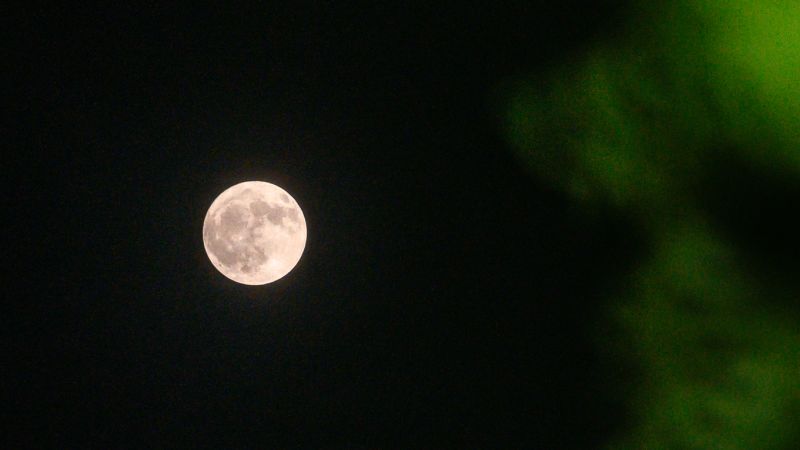
July’s full moon will grace the sky this week. Called the buck moon, it will rise in the east and reach peak illumination at 10:36 a.m. ET on Wednesday, according to The Old Farmer’s Almanac, though the moon will still look full before and after its peak.
Read more DNC Chair Ken Martin’s supporters dismiss concerns about the party’s debt and his leadership
Sky-gazers will have “flexibility as long as you’re in a place that’s free of bright lights and you have a fairly clear view of the sky,” said Noah Petro, chief of the Planetary Geology, Geophysics and Geochemistry Lab at NASA’s Goddard Space Flight Center in Greenbelt, Maryland.
The moon will appear low in the sky in the Northern Hemisphere, while for those in the Southern Hemisphere, the satellite will be high, but not as high as the June full moon, according to EarthSky.
Full moons often follow the same trajectory as the sun’s daytime path from six months ago and six months in the future, meaning the buck moon’s path will resemble the arc of the sun in January, EarthSky reports.

Sick of Earth? NASA is recruiting volunteers for a yearlong Moon and Mars simulation
How to see the buck moon
The term buck moon is derived from the full moon’s alignment with the growth period of male deer antlers. But various Indigenous groups know it by different names; it is referred to as the moon when the chokecherries are ripe by the Dakota, while the Cree call it the feather moulting moon, according to The Old Farmer’s Almanac.
Sky-gazers in the Northeast and Upper Midwest might observe the buck moon to have a more reddish or orange glow than usual. That’s because the smoke from the Canadian wildfires has polluted the atmosphere at significant levels.
If you’ve noticed recently that the sky during the daytime doesn’t look as bright blue as usual, “that’s the smoke scattering sunlight,” said Pamela Gay, senior scientist at the Planetary Science Institute. “The exact same thing is going to happen with moonlight.”
Observing the full moon is a great way to stay connected with space, experts say. As space exploration has taken center stage in recent years, viewing the cosmos from Earth can offer an opportunity to reflect on what’s beyond our planet.
“Just as we learned in April with Artemis II,” Petro said, referring to the NASA mission that successfully sent four astronauts around the moon, “there’s a real connection with everyone here on Earth and what’s going on at the moon.”
The buck moon will appear days after the 57th anniversary of the Apollo 11 mission, which saw the first human moon landing.
“We’re so fortunate to have this moon as our neighbor,” Petro said, “and we should really be celebrating that.”

Artemis II astronauts will see parts of the moon no human has before. Here’s how
Upcoming full moons
There are five more full moons in 2026. November and December will feature supermoons, when the satellite will be closest to Earth and appear largest and brightest.
Here’s the list of the remaining full moons, according to the Farmers’ Almanac.
- August 28: Sturgeon moon
- September 26: Harvest moon
- October 26: Hunter’s moon
- November 24: Beaver moon
- December 23: Cold moon
Sign up for CNN’s Wonder Theory science newsletter. Explore the universe with news on fascinating discoveries, scientific advancements and more.
Read more 4 out of 5 toddler foods are ultraprocessed. Nearly half fail to meet nutrition standards