 By admin
Maria Comstock didn’t have a phone until she was 18. By her next birthday, she had a million followers.
Read more Maine Democrats are poised to pick their Senate nominee at an unusual party convention
Her “Point of View”-style videos on dating, politics and the workforce caught the eyes of social media users and, eventually, political campaigns, who found them relatable. What began as a Covid-era hobby has turned into a job.
But as it turns out, the work of a Gen Z political influencer is a complicated, unruly business, Comstock and others can attest.
Filming, production and publishing can come with all the responsibilities of a media executive. The clients can be demanding. The atmosphere is often competitive. The pay is inconsistent. And the party you support might get voted out of office anyway.
“Everyone’s a content creator in this day and age,” says Comstock, now 24 and using her digital fluency to help Democrats. The political work is “hard to define both legally, and on campaigns, in payment systems, and it’s just a new world that’s ever, ever evolving – and it gets messy.”
Nearly 50 million Gen Z members will be eligible to vote this November, according to Tufts University’s Center for Information and Research on Civic Learning and Engagement, making it a critical base to win for both parties. Generation Z, known by its shorthand Gen Z, is a term used to describe those born from 1997-2012.
After President Donald Trump and Republicans made significant inroads with young voters in 2024 through their dominance of nontraditional media, content creators and experts say Democrats are expanding their work with influencers and attractinga growing universe of social media personalities. Meanwhile, Republicans are forging ahead with an already successful playbook.
“Whether we like it or not, influencers are not going away, and they play a big, big role in how we make sense of politics,” said Jess Rauchberg, a Seton Hall University professor who studies digital culture. “I think at this point we can say influencers also sell us politics.”
But embarking on professional political influencing means navigating a new media industry with few regulations, a dizzying array of payment structures and ever-changing political relationships, according tonearly a dozen influencers who spoke with CNN. “Authenticity” is paramount. Whether to disclose payments, which can undermine that authenticity, is subject to debate.
Influence for hire
Not all popular political influencers turn content creation into a livelihood – for some it becomes an added source of income on top of more conventional professions or simply remains a leisure activity.
For Harry Sisson, it’s become a full-time job in the six years since he started posting election content.
Now 23, Sisson wasn’t even old enough to cast a ballot when he began posting on social media to influence the Democratic votewith videos touting then-President Joe Biden.
“I was in my basement during Covid, like any other teenager,” he recalls. Everything was shut down, “so I was scrolling on social media and I saw you know, other young people talking about politics, talking about Joe Biden and Donald Trump. And I just thought I could do it too.”
Two million TikTok followers later, top Democrats court his time, and he has even caught the attention of Trump, who posted an AI video last year depicting him dumping sewage from a plane on Sisson and other protesters at a No Kings rally.
Now, Sisson wakes up to “immediately scroll the news” to look for things to post for his YouTube channel, TikTok, and Instagram; “the whole nine yards.” His management company vets his appearances and like other popular influencers, his personal life has been scrutinized. In March 2025, he faced grilling from UK broadcaster Piers Morgan after being accused of allegedly pressuring multiple women to sext him. (Sisson has apologized for his behavior but denied wrongdoing.)
An even earlier pioneer, CJ Pearson, a well-known conservative influencer, recounts an oft-told story of how he started posting political content in 2015, at age 12, after getting a camcorder for Christmas. Already interested in politics, he’d “never made a YouTube video before in my life” when he decided to record himself passionately discussing his support for Rudy Giuliani and criticizing then-President Barack Obama. He hit publish and “got 2 million views overnight.”
A cardinal rule for success, according to those with years of industry experience, is to let go and “let creators cook,” as Pearson put it.
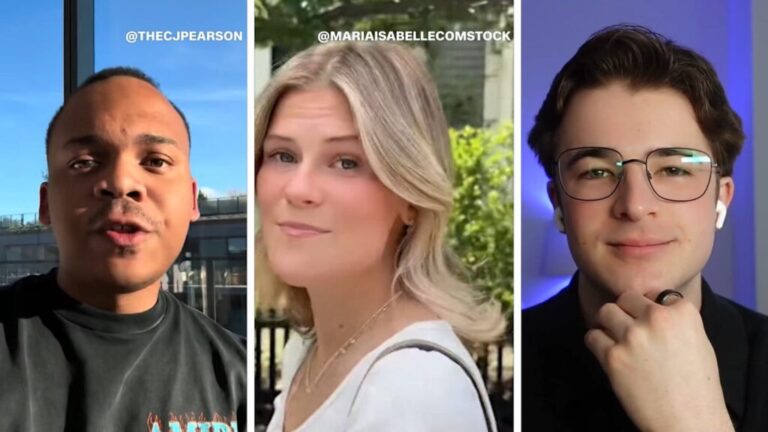
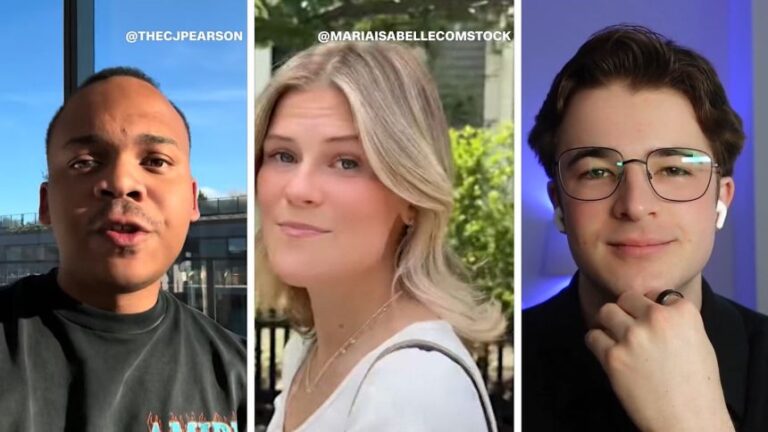
“If you have a script, buy an ad, if you want a story, hire an influencer,” quipped Comstock, who now has some 2 million followers across TikTok and Instagram.
Some political partnerships work better than others. “There are totally some Democrats out there who are very particular,” Sisson said. “They want to know questions ahead of time, what the format is going to be. They want to see a final cut and things like that,” which can rather diminish the authenticity that leads to success.
Comstock told CNN that in her experience, making political content has its risks – it can alienate consumer brands that pay some of these influencers for nonpolitical content. After posting in support of Harris, she didn’t get a brand deal for six months, she said: Some brands said her content “no longer align with our values,” Comstock said.
However, AidanKohn-Murphy, another left-leaning creator, noted that from his experience, making political content has become less risky in recent years. For some, “we’re reaching crazy sums of money,” he said.
Who is paying whom?
Pay is one of the thorniest issues in the influencing game.
In a typical paid gig, a campaign will contact creators or their agents (many of them have management) to propose “deliverables,” which could be appearances at events or videos posted to TikTok or Instagram.
A deal could be straightforward – a set fee for service – or become quite complicated. One of the most common payment arrangements for political campaigns is to pay a consultancy or media management company that then contracts influencers.
One company backed by Democratic donorspays stipends for what it calls “pro-democracy” creators to post more and thereby grow audience.
Political financing for content creators “is just growing by leaps,” according to Saurav Ghosh, the director of federal campaign finance reform at Campaign Legal Center, a watchdog group.
Read more Trump orders signs be installed outside Smithsonian museum warning of ‘inaccurate information’
Yet there are very few guardrails and little transparency.
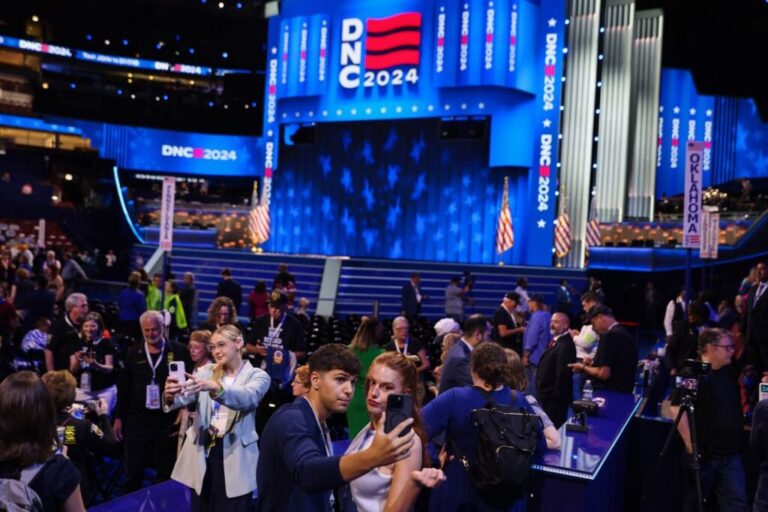
Not all posted political content is paid, but posters are not federally required to disclose if they have been given money by a campaign or outside source for a piece of political content.
Many creators who post in support of candidates also do so for specific causes or industries, but do not have to register as lobbyists. And it is hard to track the source and amount of money being paid to them.
“The lack of a clear legal requirement means that influencers are sometimes going to provide a disclaimer (about being paid), and sometimes they’re not,” Ghosh said. “So voters who are seeing that kind of content are left to fend for themselves as far as transparency goes.”
Creators who spoke to CNN revealed some of their payment arrangements.
When a marketing company hired by a pro-Kamala Harris PAC contracted Comstock, the pay depended on a prize structure. Winning the “best messaging” or “most views” against other content got you $2,500, she told CNN.
Although she sometimes discloses paid work, the post for which she won the $2,500 is not marked as paid content — she argued it was unnecessary since no one dictated the script, and the pay was not explicitly for the video but for reaching lots of people.
Though he shared that one Planned Parenthood campaign paid him $800 for a post, and that he considers even $1,000 to $2,000 a modest sum for a post, Sisson told CNN several of his deals are subject to nondisclosure agreements. Asked whether this meant he could not disclose how much he was paid or who was paying, he said it depended on the NDA, which he asserted was standard in the industry. He discloses paid partnerships with consumer brands – but CNN could not find any content disclosed as paid for by Planned Parenthood on Sisson’s social media feeds.
In April, Pearson filed paperwork under the Foreign Agents Registration Act after he was hired by the government of the Bahamas. Other work he has done, such an endorsement for solar energy, tags the energy group but remains unmarked as paid. He argues that his work is not lobbying, but “educating my audience about issues that I already care about.”
“I’m not calling, you know, members of Congress and saying, ‘Hey, let’s get this passed. Let’s make this happen,’” he said. Organizations paying him “support the work I’m already doing.”
The lack of rules and clarity can invite conspiracy, with the political influencing world frequently bubbling up with rumors or controversy over supposed puppet masters pulling the strings.
Some are not true. “I can’t tell you how many times I’ve been told I get paid by the DNC (Democratic National Committee),” says Sisson. “My response is: I’d love to be paid by the DNC, that’d be great,” he said.
But both Sisson and the DNC told CNN the committee has never paid the influencer.
Some turn out to be a source of embarrassment – such as when talking points from the American Beverage Association that were given to a conservative influencer management company, Influenceable, were leaked. Several influencers who made the posts apologized for the inauthenticity of the endorsements.
And some situations raiseuncomfortable questions. For example, in 2024, the US Justice Department indicted two Russian operatives behind Tenet Media, alleging that the company, which worked with Republican-aligned influencers to produce videos on its accounts on different social media platforms, was being secretly funded by Russian money to promote pro-Kremlin propaganda. The operatives were never arrested, but Tenet Media accounts stopped releasing videos after the indictment.
And last year, Chorus, a nonprofit that has sought to recruit and train left-leaning influencers, became the subject of intense controversy following accusations that it was receiving funding from the Sixteen Thirty Fund,a leading hub of so-called “dark” money for liberal groups that is not required to disclose its donors. The group is under investigation by a Republican-led House committee, which Chorus and other supporters have called politically motivated. Chorus told CNN that the Sixteen Thirty Fund set up legal and administrative support when it first launched and it has not received funding from the group..
Ashley St. Clair, a former MAGA social media star turned critic of the movement and the Republican Party, says she sees a predatory quality to the industry.
“Not only does it bastardize the audience, but it also corrupts the people that you’re paying,” she said. “It is a very tough economy. It’s hard for people to say no to money, and so to put them in that position where now they have to, they’re offered an opportunity that could help feed their family. I don’t think that’s right.”
Beyond politics
Yet the lines between paid speech and volunteer advocacy, sincerity and sales, politicking and mere posting have just been getting blurrier all the time, not least because, content creators say, often the most effective political influencing is not to talk about politics at all.
As an example, “President Trump would go on (podcasts) Theo Von and Andrew Schultz, and he wouldn’t talk about politics. He would talk about his cool stories from being, like, the king of Manhattan, and he would talk about the crazy cool life that he’s led,” said Pearson, contrasting what he saw as Trump’s savvy in wholly embracing nontraditional media with Harris’s hesitancy to do soduring the 2024 election.
In 2026, Democrats, who influencers and political analysts say have been on the back foot, are waking up more to the wider world of what could make for effective messaging.
“A lot of the times there’s an over index (on the left) on focusing on content creators that only cover politics, and I think it’s important for us to have people who are talking about culture and lifestyle have a seat at the table as well too,” said Lauren Kapp, a veteran of the Harris campaign who now runs Luminary Strategies, a Gen Z-led digital firm that handles social media for campaigns, political figures and organizations.
“There’s so many different stories you can tap to platforms people already have,” said Comstock. A single mother who posts content, for example, is “a really interesting surrogate, because I’m sure she’s been uniquely impacted by childcare costs, by health care costs, by all these different things.”
Those kinds of voices reflect the experience of everyday life, expressed online, that both sides are trying to capture.
“I think Democrats and Republicans both know now that if you lose online culture, you lose the election,” says Brilyn Hollyhand, a college student and conservative influencer with roughly 422,000 followers on Instagram.
“(By) culture, I don’t mean your focus groups or your political volunteers or the ones that follow every political account possible,” he said. “I mean the ones that maybe just follow me because they sit by me in class and they know nothing else about politics.”
Read more Salmonella outbreak tied to eggs has sickened 98 people since November
That’s who he is talking to when he makes political content, he said.