 By admin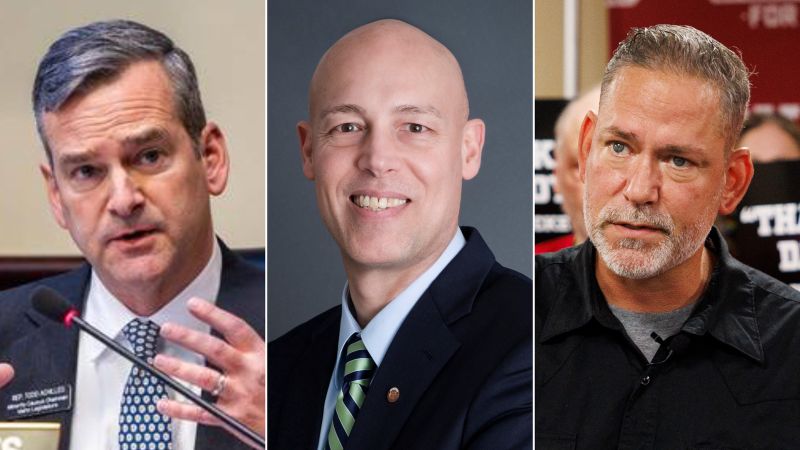
The battle for the Senate in 2026 comes with some fascinating wrinkles: In a trio of races — Idaho, Nebraska and South Dakota — the Democrat has dropped out to help an independent try to win in a red state.
Read more Experts slam ‘flawed’ Trump administration Census report on alleged noncitizen voting
But this strategy has already been attempted in a handful of Senate races in recent years, and it has yet to actually work — at least at the federal level.
So … could it this year?
It remains unlikely. But history suggests it’s worth it to keep trying. It at least gives Democrats a better shot of depriving Republicans of seats in states where a Democratic nominee probably wouldn’t have a chance at winning.
In fact, when this setup has been tried, Republicans have had some of their worst Senate results in recent history in those states.
The big examples of this strategy in recent years have been the independent candidacies of Kansas’ Greg Orman in 2014, Utah’s Evan McMullin in 2022 and Nebraska’s Dan Osborn in 2024.
Osborn, a Navy veteran and union organizer, is trying again in 2026. He’s joined in Idaho by Todd Achilles, a former state House member, and in South Dakota by Brian Bengs, a retired Air Force lieutenant colonel who previously ran for Senate as a Democrat.
Osborn’s race two years ago was arguably the most successful use of this strategy to date in a Senate race.
While he lost, he held GOP Sen. Deb Fischer to a considerably lower share of the vote (53%) than President Donald Trump took on the same ballot (59%). Osborn’s 7-point loss was also significantly closer than Democratic presidential nominee Kamala Harris’ 21-point loss.
Fischer’s performance was also the worst for a Republican in Nebraska since Democratic Sen. Ben Nelson last won the state 20 years ago.
Likewise, McMullin in 2022 came within 10 points in a state Democrats have lost by 20-plus points in each of the two presidential elections.
In Utah, it was the worst performance for a Republican Senate candidate in the last 50 years — since 1976. As in Nebraska, you have to go back to a time when the state had a Democratic senator to find a worse performance for the GOP.
Read more Trump has a new plan to crush Iran’s economy. But will he stay the course?
As for Kansas’ Orman in 2014, his performance might have been less historically impressive. But it was still impressive overall given the pro-GOP environment that year.
Orman’s 11-point loss was similar to the margins Democrats lost by in 1996 and would go on to lose by in 2020 in Kansas. But he did it in a year in which the Republican Party was gaining seats — a whopping nine of them in the Senate, in fact.
So we’ve got the worst GOP performance in the last 20 years in Nebraska, in the last 50 years in Utah, and one of the worst ones in the last 30 years in Kansas — despite it being a very good GOP year.
Those aren’t wins for the independents, but they certainly aren’t bad returns.
There was a somewhat similar situation in Alaska in 2020, when independent Al Gross won the Democratic nomination despite not being a registered Democrat. But he appeared on the ballot as the Democratic nominee. His nearly 13-point loss was somewhat unremarkable.
Alaska does, though, provide the most recent example of this kind of strategy resulting in a win — in a governor’s race, at least. Independent Bill Walker was elected by 2 points in 2014 after the Democratic nominee dropped out and became his running mate.
But there’s perhaps a good reason that happened in a governor’s race and not a Senate race. History shows Senate races tend to be more polarized. People view the candidates more as votes for one party or the other, and crossover votes aren’t as plentiful.
That also might explain a phenomenon that’s become common in these races — that these independents tend to poll better than they ultimately perform. In the cases of Orman, Gross and McMullin, there was some thought heading into Election Day that they might actually win. But then — perhaps because conservative voters realized this would cost Republicans votes — they lost by wider margins.
All that being said, just because this setup seems to cost the GOP votes doesn’t mean it might cost them in Idaho, Nebraska and South Dakota in 2026. Idaho and South Dakota, in particular, might just be too red for it to work even in the best circumstances.
But it’s also worth pointing out something about the years in which this was truly tried: 2014, 2022 and 2024. In fact, none of them were truly good years for Democrats. The 2022 election was the closest, and it was a pretty evenly split one.
For Democrats, the optimistic case is that this has worked somewhat in the past, and it might work more now that they have the wind at their backs.
Read more Key Trump legislative advisor to depart with potentially bruising midterm looming
And at the very least, it’s worth a shot.