 By admin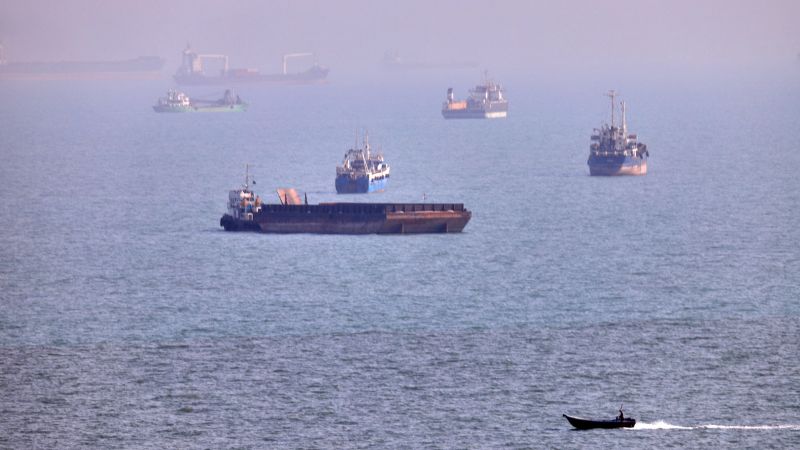
This week, President Donald Trump has: threatened to go to war with a second Middle Eastern country, floated making the Strait of Hormuz a US territory and contradicted his administration’s messaging by claiming there are no ongoing negotiations with Iran.
Read more Judge allows Trump administration to end deportation protections for thousands of Ethiopians
It’s only Tuesday.
Trump is no stranger to eccentric comments. But the Iran war has proved to be a frequent outlet for this behavior — with huge stakes involved.
His commentary has, at times, sounded like he’s not terribly engaged or clued in to what’s happening. At other points, he’s made seemingly unfeasible proposals. Several times, he seems to be trying to will an alternate reality into existence.
Here are some of the most bizarre Trump comments of the nearly six-month-old war.
Praising Iran’s leaders as ‘rational’ and ‘not radicalized’
“We’re dealing with people that I think are very rational people,” Trump said June 16 at the G7 summit in France. “They were nice to deal with. They were strong people, smart people. … But they’re not radicalized, and they’re, you know, looking to help their country.”
Many criticized these comments as Pollyannaish. And it didn’t take long for Trump to eat his words.
Just three weeks later, after negotiations predictably fell apart, Trump called these same leaders “cuckoo,” “evil,” “sick,” “dirty players” and “scum.”
“They violate the agreement every day,” Trump said at a NATO summit in Turkey. “They lie. They cheat.”
Claiming Iran had ‘agreed to everything’ back in April
Trump told CBS News on April 17 that Iran had “agreed to everything” the US demanded. That included Tehran stopping its backing of proxy groups like Hamas and Hezbollah, relinquishing its enriched uranium stockpile and committing to stop enriching uranium forever.
None of those claims came to fruition, nor is there evidence Iran actually agreed to them.
Even when Iran and the United States reached a memorandum of understanding in June, it contained none of those items.
Repeatedly claiming a deal was around the corner
Trump has frequently claimed that Iran has been desperate to make a deal and that such an agreement was just around the corner.
As far back as April 7, Trump claimed on social media that negotiations were “very far along” but needed two weeks “to be finalized and consummated.” He concluded by saying that “it is an Honor to have this Longterm problem close to resolution.”
That resolution has still not arrived.
The president had made such claims more than three dozen times by mid-June. And he’s continued making them since then, despite Iran signaling the opposite of desperation, including by violating the memorandum of understanding, which included favorable terms for Tehran.
A ‘joint venture’ with Iran on charging tolls in the Strait of Hormuz
Long before Trump floated the US taking control of the Strait of Hormuz, he floated another idea: the United States entering into a partnership with Iran to charge tolls to cross the critical waterway.
“We’re thinking of doing it as a joint venture. It’s a way of securing it — also securing it from lots of other people,” Trump told ABC News’ Jonathan Karl on April 8, adding: “It’s a beautiful thing.”
Never mind that Iran has been an adversary for nearly five decades, with its citizens famously chanting “death to America.”
And never mind that Secretary of State Marco Rubio previously called charging tolls to cross the international waterway “illegal” and “dangerous for the world.”
Claiming other Gulf countries had joined the war, when they hadn’t
Trump said March 9 that Iran’s Middle Eastern neighbors “were largely neutral” until Iran attacked them.
“The neighbors came on to our side and started attacking them, and actually quite successfully,” Trump said. “If you look at Saudi Arabia, you look at UAE, Qatar and others.”
Read more Judge rules FBI can’t abandon Biden-era plan to relocate headquarters to Maryland
This had not, in fact, happened. Other Gulf countries have steadfastly sought to avoid getting involved in the war, though Saudi Arabia last month did get dragged into it, somewhat.
Claiming the war was ‘pretty much’ over — more than five months ago
That same day, Trump told CBS News: “I think the war is very complete, pretty much.”
That was 10 days into a war that has now lasted 172 days.
Saying Iran has a right to have some missiles
“They have to have some, because other people have some,” Trump said June 17, while trying to forge a deal with Iran. He added that “missiles aren’t the problem” because “they don’t blow up the planet.”
“In relative proportion, I think it’s OK,” Trump said later.
These comments were a stark and confusing contrast to Trump saying when the war began that one of his top goals was to “raze their missile industry to the ground.” Trump has pitched Iran’s missiles as an unacceptable risk to the region, including to the US troops stationed in it.
Floating US help with nation-building
“It’s the beginning of building a new country,” Trump said on March 9.
He added on April 6: “We may even get involved with helping them rebuild their nation.”
These comments came after Trump spent many years decrying the folly of nation-building overseas — especially in the Middle East.
And like many of Trump’s ideas, he seemed to quickly abandon this one.
Claiming total control over Iran’s skies
Early in the war, both Trump and Defense Secretary Pete Hegseth claimed the United States had free rein over the skies of Iran, with the president saying Tehran “can’t do a thing about it.”
By early April, two US jets were taken down.
But Trump kept making this claim. He said in June, “We now have complete and total control of the skies over Iran.” He added in July that Iran had “nothing” militarily, including “no air force” and that their “anti-aircraft is gone.”
Just five days later, though, the administration secretly moved Trump from Air Force One to a smaller plane when he was departing Turkey, over fears that Iran could take down the larger plane.
Claiming the US controls the Strait of Hormuz
Trump has claimed over and over again in recent weeks that the United States controls the Strait of Hormuz, and that the strait is “open.”
“They don’t have control,” Trump said Wednesday. “We have total control. We own it.”
The US does have a blockade against Iranian ports in the strait, which is applying economic pressure on Tehran. But Trump hasn’t been able to force the strait open as Iran keeps attacking ships. And traffic remains far below the prewar peaks.
Indeed, the Strait of Hormuz is basically Iran’s leverage at this point. And if the US actually controlled it, the war would look very different.
Turning the Strait of Hormuz into a US territory
This wasn’t just some internet meme that Trump fired off Tuesday morning. He also said Monday: “I think it’s a great idea. We control it. I like the idea of declaring it a territory.”
But this seems, at the very least, entirely impractical. Not only does the US not really control the strait now, but holding it over the long term would likely require an extended troop presence in a volatile region. It’s an odd goal from a president who repeatedly said the war would last only four to six weeks and who has lambasted “forever wars.”
Of course, Trump says stuff like this a lot. Last year, he briefly floated a plan to take control of Gaza. That went over like a lead balloon, and there’s been almost nothing about it since then.
Threatening to bomb Oman
“If Oman gets in the way, we’ll bomb the sh*t out of them,” Trump said in an interview this week with Fox News’ Trey Yingst.
Trump fires off lots of threats, but this one — which the president initially made in May and then re-upped on Monday — has left allies in the region thoroughly confused.
Oman has been a historic partner for the United States and a mediator during negotiations with Iran. And while Trump warned Oman on Monday not to interfere, he previously — in a signed document — said that Oman would “conduct dialogue” with Tehran to determine the future administration and maritime services in the Strait of Hormuz.
Read more I’m a running coach with arthritis. These are the best shoes for knee pain